|
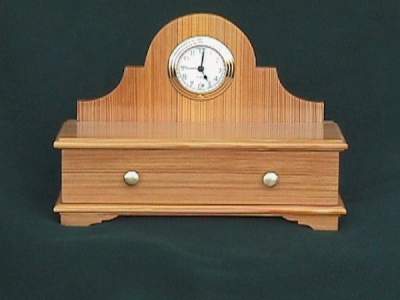
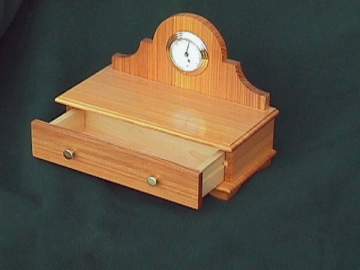
HEART PINE RING BOXA century underwater and the pitch still gums up tools. SHOP OWNER: R.P. "Bob" Aspey LOCATION: Dover, PA Here is what I call a "ring box". I used Heart Pine (determined with help from WoodCentral) that had been underwater in the Susquehanna River since about 1903. I retrieved it from the Hydro Plant in the mid 1990's. The pine was part of sill beams used to seal the hydro pit from the river so the workers could perform maintenance. The beams originally measured 16" x 24"x about 16'. Divers cut the beams into 4' sections in order to lift them out of the fore bay with a crane. I was able to save about two of these beams, but because they were so heavy I had to cut them in half again. I resawed the heavy timbers into 2" thick slabs, coated the ends with latex paint, and set them in my attic to dry. Wanting to make something from the wood just to try it, I came up with this box. The lumber was a real pain to work with. First, the pitch gummed up all cutting edges very quickly. Then there was the odor, which was like turpentine and river muck combined. It smelled nasty! In fact, when the pitch build-up began to get hot, the smell would make me start feeling queasy. The wood is also very brittle.
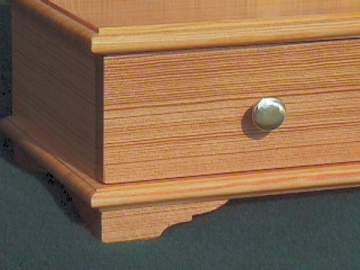
The finish consists of many wiped on coats of 1 pound-cut blond shellac. I lost count of the number of coats and the box is still not completely sealed. The wood just kept sucking in the shellac. A neat thing the pictures do not show is that the light rings became somewhat translucent. The secondary wood is maple. Even though there isn't any wild grain, I think the box is very interesting. I wasn't concerned with cross grain movement on the back because I quartersawed the stock and the rings are almost perfectly straight across the thickness of the board. I originally wanted to have a molding around the back and a raised ring around the clock but I was a bit unsure how to accomplish this. Now that I have more confidence, I would like to try it all over again, but that smell... it was noxious!
The dimensions are: 10 " wide x 8" tall (including back) x 5" deep. The drawer face is 2" wide and has about 64 dark rings across it. The clock mechanism is a quartz slip-in unit with alarm. The stock is 1/2" thick for the back and 3/8" for the rest except the bracket feet, which is 1/4" thick.
. . . R.P. "Bob" Aspey
|

Comments (0)
No comments yet. Be the first!
Leave a Comment