Bosch 1370DEVS ROS/Polisher
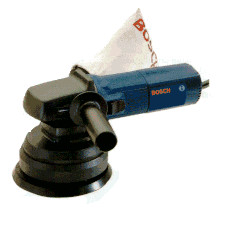
List Price: $446.00, Street Price: about $250, additional $20 for vacuum kit
Purchased my unit from: Klingspor
Important Specs: 6" hook and loop, 5 amps, 4,000-12,000 rpm, soft start, 5 pounds, barrel grip with side handle, unit is about 10" long, has a nice long (12'?) power cord.
Similar units owned/compared to: Dewalt 423
I purchased this unit due to it's size (6" pad), amperage and flexibility to be used as a polisher. My wood projects typically have large surface areas of some kind to be sanded. There are also a wealth of optional accessories available for this model, and I've had good luck with Bosch tools in the past.
Sanding
First things first - don't even think of using this sander without the optional vacuum kit. The difference between using the dust bag versus the vacuum kit is like night and day. With just the dust bag (which apparently is so named because it appears to create dust all by itself and then fluffs it across the entire room) this beast will spew volumes of dust quicker than you can get your first cough out, more than I've seen any type of sander of any size produce. After five minutes of this test I started looking for Toto and shouting "Auntie Em! Auntie Em!". I almost decided to return the unit right then and there.
But to be fair and diligent about such things, I plugged the vacuum kit into the shop vac. Initial impression, just by placing my hand over the holes on the pad, was "uh-oh, looks like a return". Not a ton of suction at the business end - less than I expected - but then again the 1.5" hose itself is 16' long. Thinking I've got nothing to lose at this point, I went at some glued-up cherry panels with respirator, goggles, etc. in tow (I looked like I fell out of an Intel commercial).
Five minutes went by, then 10, 20 - what's this? No fine dust? NONE? Gosh. This can't be the same sander that 20 minutes earlier had sent up enough dust to alert the EPA to a new hazardous site. I went on my merry way, kicking up not an iota of dust. Environmental testing - passed. As far as actual sanding performance, at 80 grit this machine can smooth out a surface roughly as fast as a belt sander, but with the obvious control advantages. I should mention I use Klingspor discs exclusively on all my sanders, your mileage may vary if you use another manufacturers discs.
The 6" pad is nice in that it smooths out peaks and valleys to a much greater degree than a 5" (there's 44% more pad surface) so the final surface has a much better chance of being flat.
This machine turned up to full 12,000 rpm is a true whirling dervish. If not used with care, it can definitely fly out of your hands and have you chasing it down the street like a bad episode of "I Love Lucy" - long after it unplugs itself. OK, that's an exaggeration, but balance seems to be the key, in that keeping both hands on the unit in somewhat of a balanced grip is the best way to control the machine. This makes the side handle more or less useless at the higher rpm's - one hand is on the barrel grip behind the pad and the other is on a small hand rest ahead of the pad. In this manner it's pretty controllable. The Dewalt 423, a lighter 5" model with lower rpm's, can be used one-handed without any stress, and it's design forces your hand directly above the pad. The Bosch is a chore to use one-handed in the same manner, although it can be done for brief respites.
Given any length of time using this tool and you'll definitely "feel the buzz" in your fingers and palms. It's the gift that keeps on giving as well - takes about 5 minutes after you've shut the unit down to lose all the tingling. This is after about 60-90 minutes straight use and while playing with varying rpm's. A subsequent session of about 30 minutes produced no tingling at all.
Overall, this unit in sanding mode does exactly what I'd hoped:
- It controls the fine dust very well with the vacuum attachment
- It can take off large amounts of material or cover a large surface area quickly
- It comes very close to a belt sander with much more control
- It creates an overall more consistent surface than smaller ROS units
- For me, it was well worth the purchase price even if only used for sanding
But wait, there's more ...
Polishing
In order to change the unit over to polishing mode, you must take the pad out of "direct drive" mode, meaning the pad won't continue digging into a surface when resistance is met. The changeover is fairly simple and well-covered in the manual, but it does involve taking the pad off the machine.
Since I've not yet used it for polishing I'll stop right here. The polishing pads and stuff are extra. If you are reading this and would like an update on the polishing performance, feel free to email me and hopefully by that time I'll have used the polishing features.
Paul Jordan - 4/2/98
Comments (0)
No comments yet. Be the first!
Leave a Comment