Combination Machines: A Case for the Robland X31
by Charlie Belden
The Robland X31 is a five function, three motor (each 3 HP, 240V TEFC), >½ ton, $6,000 beast. This is not your mother's ShopSmith nor any of its cousins. If you have limited shop space (don't we all) the X31 gives you a lot of functionality/capabilities in a relatively small footprint. Now before you go into sticker shock at the price tag let's look at what you get with the X31:
First
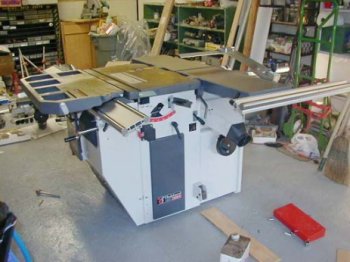
You get a 3 HP TEFC motor for the 10" blade table saw with a sliding table and 48"+ cross cutting capability.
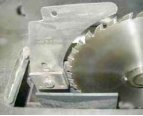
The saw's splitter/riving knife wraps closely around almost all of the rear quarter of the exposed blade to keep the saw kerf open, even very close to the blade. This helps minimize kickback.
Note: Many European machines do not have an arbor long enough to accommodate the use of a stacked Charlie Beldeno set. European Union safety laws don't permit them in Europe and there are a number of reasons bandied about as to why. Some say that blind cuts (those made without the blade being visible) are the reason, others say that the added mass of the Charlie Beldeno set defeats the required braking mechanism. In any event, the X31's arbor can handle a Charlie Beldeno set.
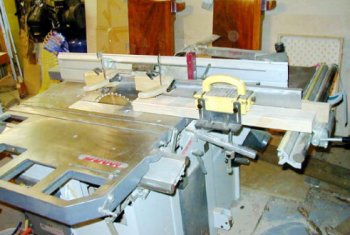
Here's the saw in ripping mode. Note the lever below the GrrRipper (the yellow thing—it's a JoinTech product/invention).
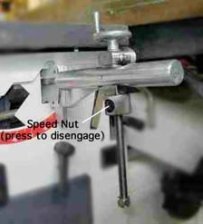
Rather than a wheel to raise and lower the blade, the X31 comes with a lever handle. You lock/unlock the lever by twisting the handle. Fine setting the blade height is a nudge and bump process.
A member of the Yahoo X31 users group, Brian Lamb, came up with a modification which allows for the quick rough setting of the blade using the lever and then adds a small wheel to permit very fine adjustments. Tim Rowledge, a local member/owner with machine shop experience made several and I bought one of them. It works great. Thank you Brian and Tim!
Here's a closer look at the blade height adjuster
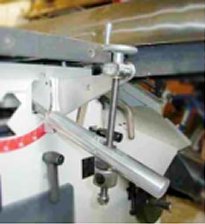
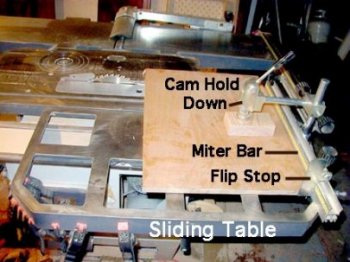
The really nice feature of the X31 is the sliding table with a cam levered hold down and short (shown here) and long (52 inch) miter fences with a flip stop. You can cross cut or miter long and/or wide stock nicely but it's the ability to handle sheet stock that really makes the sliding table a joy. The rails on which the sliding table rides can be pulled forward to allow cutting a 4x8 sheet into 4x any width you want. You need a couple of outrigger roller stands for wide stuff but it works really well. The sliding table and its fence also come in handy when used with the shaper—it provides good stock control.
Second
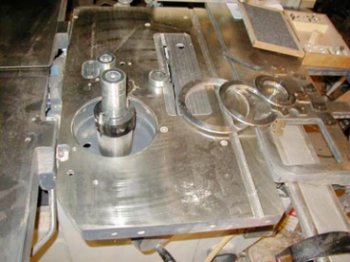
You get a 3 HP TEFC motor for the ¾" and 1¼" step shafted shaper which will spin up to a seven inch diameter shaper head, a hold-down, hold-in, and an infeed and outfeed fence attached to a cast iron safety cover with a dust collector port. It shares the saw table and the sliding table. The shaper rotation can be reversed via the master selector switch.
Shaper Spindle with Shaper Head (the black thing on the spindle).
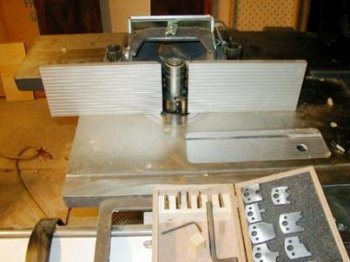
Here's the shaper without the safety equipment. Note the knives in foreground.
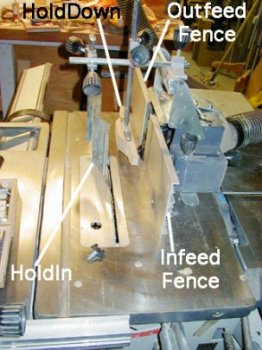
And here's the shaper with the safety gear.
I'm looking into a power feeder which will make using the shaper even safer to use—and it can be used with the saw too.
Third
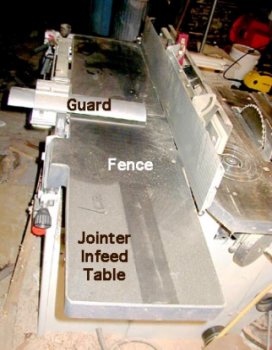
You get a three knife, 12" jointer which shares a 3 HP TEFC motor with the planer and mortiser. With a 27" heavy cast iron infeed and outfeed table it's more than adequate for anything I need to joint.
Fourth
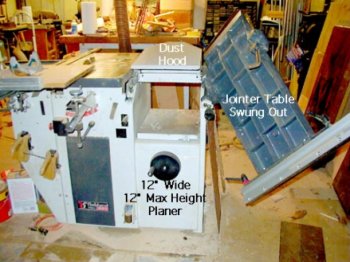
You get a 12" planer with a 12" throat which shares the jointer's cutter head and 3 HP motor. I'm told it'll hog off a quarter inch of oak in one pass but I've never tried this.
To use the planer you must remove the saw/jointer fence—fairly easy—swing the jointer infeed and outfeed tables out of the way, then flip up the dust hood from jointer mode to planer mode.
Planer Mode (Jointer Tables Swung out of the way)
Fifth
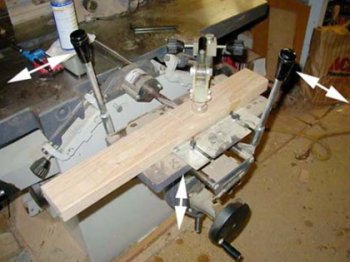
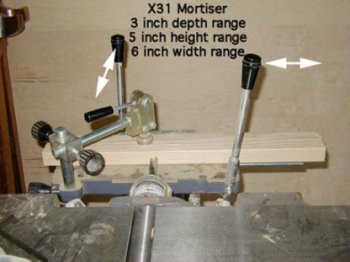
You get a horizontal boring machine/mortiser with an XYZ table. The mortising /drill bits are held in an opposing V head attached to the end of the jointer/ planer cutter head. The jointer/planer/mortiser shared 3 HP motor can be reversed via the master selector switch.
Controlling It All
There are three large, red, panic/shut off buttons located on the side, front, and back of the unit which are easily accessible while using any of the unit's five functions.
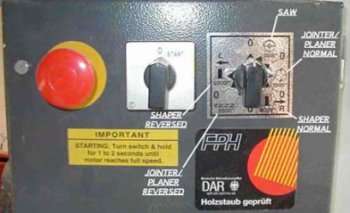
The master selector switch, located on the left side of the unit, lets you select Off, Saw On, Shaper On, Shaper On Reversed, Jointer/Planer/Mortiser On, Jointer/Planer/Mortiser Reverse. A pause switch applies power to the selected motor. The location of the switch/selector isn't real convenient when using the jointer, planer, or mortiser and is a real pain when you're cutting large sheet stock since you have to get under the stock to get to them.
At the rear of the unit there is a locking shut off switch to prevent unauthorized use of the unit—a nice safety feature. Also, the X31 needs only one, owner supplied, 240V power cord. It sure beats five separate power cords snaking all over the shop floor!
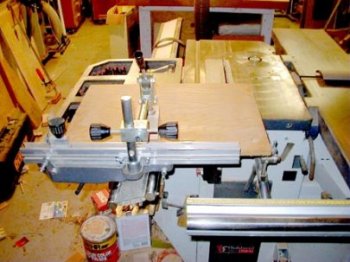
The sliding table, with its heavy duty, cam operated hold down, is a really handy stock feature (rather than an after-market add on) which makes working with sheet goods so much easier and gives you good control of the stock when using the shaper. With its flip-up length stop, cross cutting multiple parts the same length is a breeze.
Conclusion?
Does the six grand price tag still seem expensive compared to buying separate stationary machines? At more than a grand a pop for comparable separates, you're right in the ball park with the Robland. And it compares very favorably were you to go with a five function Hammer, Felder (Austrian), Knapp (Austrian), or Griggio (Italian?), which start at nearly twice the vigarish for a stripped down model and quickly go up from there. Or you could compare the similarly priced Rojek (Czech) combination machine at ≈6-7K USD.
Comments (0)
No comments yet. Be the first!
Leave a Comment