Turning in the Good Old Days…
Excerpts from The Messageboards
Wally Dickerman in AZ wrote: I was there. Okay, you have a nice hardwood blank, 12 x 4½". You want to turn a salad bowl. But wait…it's 1980. The bowl gouge was invented in England in the '70s, but didn't reach the U.S. until after 1980, and didn't become popular for at least two or three years. So you have no bowl gouge. The 4-jaw chuck wasn't marketed until about 1990, so you don't have that. High speed steel isn't in general use for turning tools, so your tools are carbon steel. Tools available are for spindle turning anyway. You'll have to use those or make your own bowl turning tools. There aren't any videos. Books available are mostly on spindle turning. There are certainly no woodturning websites. If there are any clubs they're for general woodworking and seldom for woodturning. Lathes are constructed for spindle turning. No swiveling or sliding headstocks, no electronic variable speed, and very few have a swing of more than 12 inches.
Now tell me, how are you going to turn that salad bowl? We've come a long way in 25 years.
Russ Fairfield: In 1970, I would have held the wood between centers, turned the outside with a tool that we now call a scraper, and hollowed out the inside with a narrow scraper that was about 1" thick—or maybe I would have hollowed it out with a steel bar that had a piece of ½" HSS held in a hole in the end with a set-screw. Then I would have cut off the long center spigot, and smoothed the bottom with a wood chisel and a cabinet scraper. I didn't sand bowls in those days because I could get a surface with the scraper that didn't need sanding. Come to think about it, it's still a good way to turn a bowl. Just so it isn't too deep. The bowls I make now aren't any better. They are just faster.
John Lucas: Wally, were you trying to describe me? No actually my first real lathe other than using a drill mounted to the bench was the Shopsmith so I had a halfway decent lathe. All the lathes I could afford back then had minimum speeds of 500 rpm and were light weight. I spent a lot of time chasing them around the shop. It was a long time before I could afford a chuck and turned everything on faceplates. Glad I did. I still use those techniques today. Tools. Don't cringe. I used files and screwdrivers. Later I learned to heat treat the files to make them less dangerous. I turned all my early bowls with scrapers. I did finally buy a spindle gouge and would turn the outside and part of the inside with the gouge. My bowls always had a sharp turn from the sides to the bottom so I had to scrape the bottom.
I don't remember what sandpaper I used but I'm guessing somewhere between 24 and 80 grit. I still didn't sand out all the tearout. My mom has one of those bowls and even though it looks nice there is tearout in places.
My finishing was good because I came to turning from furniture making. I felt sanding and finishing seperated the Men from the boys, so to speak, so I spent a lot of time doing that. Besides my shapes sucked and I had to sand them into submission. It was a real revelation when I saw Clay Foster use a cabinet scraper. I already had a couple of those. In that same demo (my first by the way) Rude Osolnik showed his first bowl gouge. A rectangular piece of steel with a groove cut in the top and the bevel shaped kind of like we have today. I went home and built one. Used it for years until I bough my first Robert Sorby bowl gouge.
Brian Hahn in SW Wisconsin: Was there, did that. Craftsman 12" steel tube bed lathe with speed reducer to bring the RPM down to a reasonably safe level. Used a spindle gouge and scrapers. Glued the foot to a waste block to turn the inside. That was mostly scrapers, and the finish was good if I didn't get a bad vibration. Hand sanding—no Velcro pads back then either. Then part the bowl off—the paper-in-the-glue-line never worked well for me.
Bob Hackett: You could always take the approach my older brother took. Get your younger brother, the metalworker, involved in turning so he would make tools, adapters, etc for you. I think I mentioned it before, but I got him hooked on metalworking to get back at him. Now if I could just get a small percentage of my tools back…
David Probst: Yesterday I found the speech linked below by Ellsworth on "Early Woodturning Masters" while looking for some info on Rude Osolnik's candle sticks. It is good reading and fits in nicely with your post. Early Woodturning Masters…
Wally Dickerman in AZ: You're right David, it is good reading. I've been around the turning scene so long that I've met all of the men that Ellsworth writes about, including David himself. I consider myself fortunate to have known Rude Osolnik quite well. I visited him at his home in Berea, and he stayed with me several times when he was in Seattle. As David points out, these pioneers of the types of turning that we know today, all started on their own. They had to make their own tools and came up with the techniques needed to do the style of turning that they wanted to do.
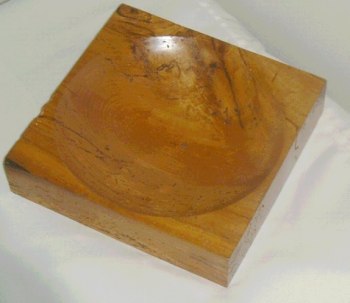
Ed Karch in northern VA: I have that bowl in my display case. Done in 1975 from California Laurel on a face plate with three screws (you can see the holes in the bottom). Not a true salad bowl as the outside is square not turned. More of a coffee table piece. Done on a Shopsmith with scrapers made from files. Finished with many layers of boiled linseed oil. Didn't turn another thing for 28 years.
Wally Dickerman in AZ: There has been a virtual explosion in the number of people involved in woodturning since about the middle '80s. I give most of the credit for this to the creation of the bowl gouge. All of a sudden bowl turning became easy (compared to the methods and tools we used in the old days).
Most of my bowl turning in the old days was done with scrapers. I made a very good one out a car leaf spring. I took it to a blacksmith and had him temper it to hold an edge (the price was a wooden bowl). A couple of the tools that I used, I still use in my turning today. Or copies of them. A ½x½", long and strong scraper I use when hollowing the lower portion of some of my hollow forms. Hogs out wood fast and easy. A square nosed scraper, side ground for an inch on both sides is a very handy tool for many uses.
I used a faceplate for the bottom of the bowl. I later made a screw chuck, using a lag bolt, a piece of wood and faceplate. To finish the bottom, I usually shortened the foot a little and used a wood plug for the hole in the center. That was perfectly okay in those days. In fact in R. Raffan's book on bowl design there is a photo of one of my early-day pieces, showing the plug.
Keith Tompkins: I had no idea what a bowl gouge was…
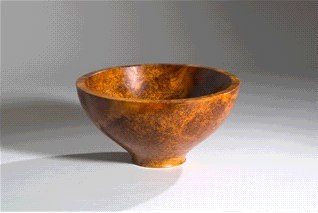
Good post, Wally. Here is a photo of a bowl I made with only a Craftsman spindle gouge. I started turning in high school, and continued while employed as a traditional cabinetmaker. I was making really strange cabinet pieces and turnings back in the early '70s….while at work in my spare time. My boss would walk past and shake his head in dismay! One day he called me into his office after observing one of my pieces. I thought to myself, “oh boy, I just got myself fired for goofing off on company time!” Instead, he made me his personal assistant!
I had no idea of the turning movement that was underway…I can only imagine if I did! When I saw the book by Ray Leier and Jan Peters, I almost fell off my chair!!
Comments (0)
No comments yet. Be the first!
Leave a Comment