Testing Chisels - Part 1
by Bill Tindall, Phil Smith, and Spencer Hochstetler
This first in a series discusses factors that affect the edge holding ability of chisels used for chopping cuts such as chopping out mortises and dovetail waste. Later posts will discuss the testing of edge holding ability.
Background:
A cutting edge can become dull by abrasion where the metal at the edge is simply worn away with use. While this could be the primary dulling action for a plane iron, a chopping chisel becomes dull either by chipping at the edge or by the edge collapsing, or crumbling, under the chopping force. The failure mode encountered depends on the nature of the steel and the hardness to which it was tempered.

Figure 1 shows dulling by chipping while Figure 2 shows a different steel which dulls by collapsing. It is not clear to the authors which mode of failure is preferred. Either mode makes the chisel dull and the remedy is regrinding to restore the edge.
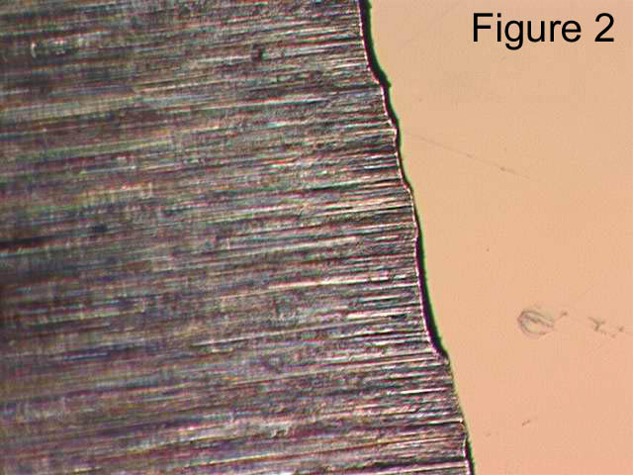
These pictures were taken at 100X with a high quality industrial microscope and digital camera to show the effects described. However, these features can easily be seen with a high quality 10X lens. Therefore, it is possible to do your own testing and observations of dulling and edge failure and we encourage further exploration of this subject.
An edge's tendency to fail strongly depends on the bevel angle. Larger angles provide better support at the edge, but there is a price to pay: they require more force for penetration. Another drawback of large bevel angles shows up when chopping dovetails and mortises. For these operations, a cut that is perfectly perpendicular to the plane of the board is required. A larger bevel angle results in a greater deflection force away from perpendicular, which makes the cut harder to control. A few degrees difference in bevel angle can make a large difference in all these factors. In general, to minimize penetration force and unwanted deflection forces, chisels should be sharpened at the smallest bevel angle that will support a long lasting edge. Experience has shown that this angle will vary among chisels depending on the steel and tempering used in their construction. It is common to see mortise chisels sharpened at 35 degrees, Japanese chisels sharpened at 30 degrees and western bench chisels sharpened at something less than 30.
From this discussion it would follow that the "best" chisel would be made from steel that could be sharpened at the smallest bevel angle that would support the edge well enough to prevent chipping or collapsing under normal use. Future posts will describe our quest to identify such a steel.
Chisel Construction:
Western Chisels are typically forged or cast into their typical shapes. Forging is the process where the desired shape is achieved by hammering the steel. Not all steels can be readily forged so a desire to achieve traditional chisel shapes limits the choices of chisel steel and rules out some of the modern high performance steels. Knifemakers face this same situation as traditional knife shapes were forged also. Therefore, to use some of the modern "unforge-able" steels, a departure from traditional chisel construction techniques is necessary. More details on this topic will be discussed in a later post. Japanese chisels are made from a layer of very hard (and very brittle) steel laminated to a softer steel back. The softer, more ductile back provides support of the sharp, but brittle steel for the cutting edge. This sword construction technique provides considerable benefit to swords that can fail by breaking in use. However, this construction does not provide any inherent advantage for knives and chisels where simple dulling of the cutting edge is most relevant. The soft backing does nothing to prevent dulling by micro-chipping at the brittle cutting edge.
Typically, one would expect that the minimum bevel angle in a Japanese chisel would be limited by micro-chipping and for western chisels the bevel angle would be limited by collapse of the softer, more ductile western steel. The choice between these chisel types could become quite personal according to the preferences of trade-offs between durability and the advantages of smaller bevel angle.
There is hope that better woodworking steels can be found. Modern steels have outperformed traditional knife steels by such a great degree that knives made from these new steels are no longer allowed to compete against forged steel knives in knifemakers' competitions.
The next post in this series will discuss the testing procedure and describe how some typical chisels hold up under dovetail chopping conditions. In particular we wanted to see how chisels made from a new steel, CPM 3V (Crucible Materials Corp.), compared to some typical traditional chisels. Even at Rc62, knifemakers have never seen a chipping failure for CPM 3V and their bone tests are more brutal than chopping maple. Some very popular and expensive chisels failed miserably in our tests.
Comments (0)
No comments yet. Be the first!
Leave a Comment