Combination Machines

One of the main reasons I came along on this trip was to see if I could find out why combination machines are apparently so popular in Europe, while they remain relatively scarce in America.
Combination machines are well-suited to small, one-man shops because they combine several major machines in a single chassis, making them more economical to buy and easier to fit into tight spaces like garages and basements.
American public opinion about combination machines, according to Guido Blomme, Robland's sales manager, has been biased by what he terms the "Shopsmith phenomenon," referring to the lathe-based "multi-purpose" machines manufactured by Shopsmith Inc., of Dayton, OH. Shopsmith has sold over a half-million of these machines in the course of the companys 51-year history, and countless thousands of Taiwanese knockoffs have also made their way into the shops of amateur American woodworkers, who are attracted by the prospect of getting up and running in a hurry and at a low price.
Shopsmiths, which operate off a single 1 1/8 HP motor, are lightweight machines compared with European-style, tablesaw-based machines. They require a fair amount of fiddling in order to convert from one function to another. In contrast, European combination machines, including the Robland X31, weigh over five times as much as a Shopsmith Mark V and are powered by as many as three 3-5 HP motors. Each function--tablesaw, shaper, jointer, planer, mortiser--is a heavy-duty, dedicated machine in itself, and changeover time is negligible.
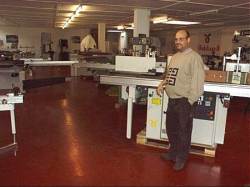
We learned that there is a thriving population of hobbyist and part-time professional woodworkers in Belgium and, presumably, in other Western European countries as well. Generations of these hobbyists learned their woodworking on combination machines in the school systems, so they are used to the idea. Many do not sell enough of their work to justify the expense of separate woodworking machines, nor do they have the room in their homes or outbuildings for several dedicated machines, so "combo" combination machines are popular.
I had expected to find combination machines in larger shops as well; but, according to Ludo Leirens, a machinery dealer we visited in the village of Kalken, commercial shops in Europe are only interested in separate, larger machines. Apparently, as soon as there is more than one worker in the shop, combination machines become logistically outmoded. Professional woodworkers who own combination machines generally move up to separate machines--notably panel saws, line drilling machines and edgebanders-and reserve their combination machines for a single dedicated function, such as jointing or slot mortising. The same fate catches up with many Shopsmith machines in the U.S. as their owners advance to heavier-duty, individual machines.
© 1998 by Ellis Walentine. All rights reserved. No parts of this publication may be reproduced in any form or by any means without the written permission of the publisher.
Comments (0)
No comments yet. Be the first!
Leave a Comment