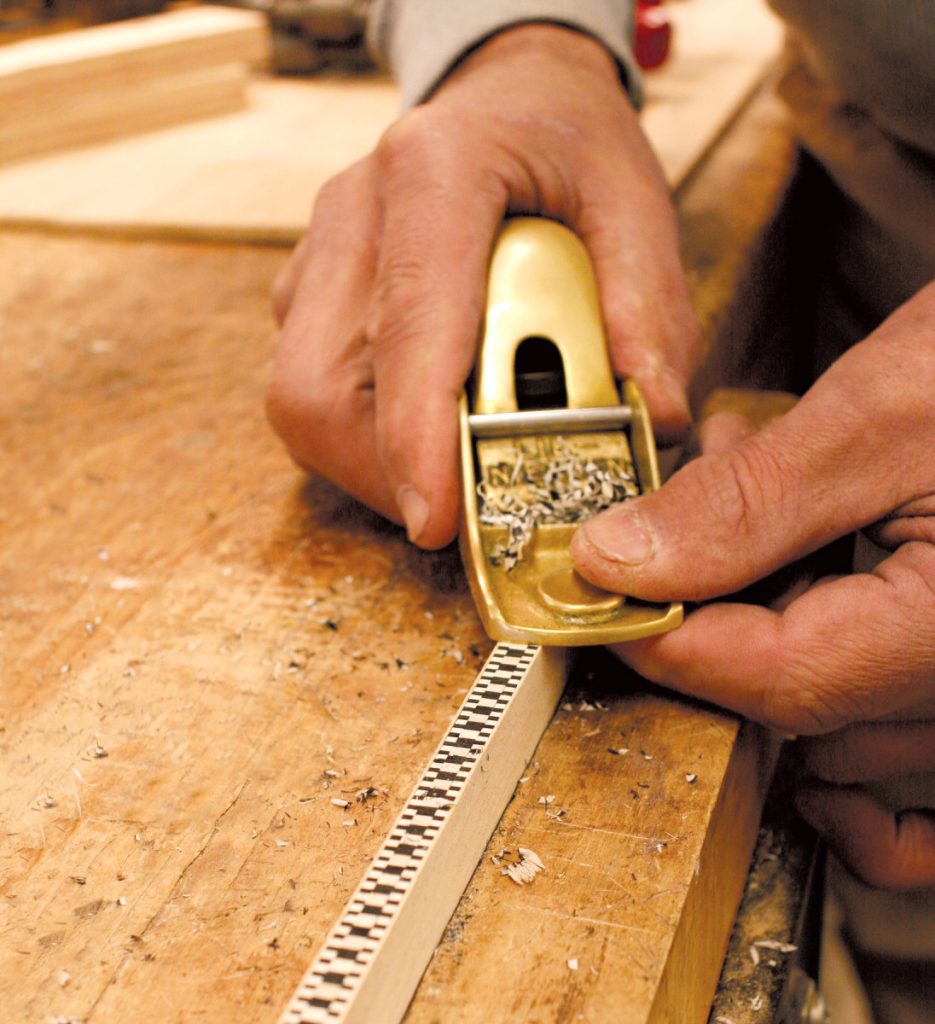
A mark of true craftsmanship, bandings are much more than just decoration. Stop for a moment and take a good look at a piece of furniture that you admire—say, a card table from the Federal era. At first glance, you …
At a simple level, veneering is the process of applying thin layers of decorative wood over less expensive structural materials. There are many ways to do this, but some of the most refined techniques were developed centuries ago by 17th and 18th century furniture makers who perfected the technique we now call “hammer veneering.” As we learn here, a few modern-day artisans still prefer this time-honored technique to create the highest quality work. One of those practitioners is San Diego-based furniture conservator Patrick Edwards, an accomplished furniture maker, woodworking historian, and hand-tool expert.
In this video, without the benefit of powered vacuum presses or perfectly flat plywood substrates, Patrick reveals an entire hammer veneering process. You’ll learn step-by-step how to “tooth” or make perfectly flat the substrate wood, how to glue down simple veneers using a veneer hammer & animal protein glues, how to create an exquisitely tight veneered joint, how to insert decorative inlays, and how best to prepare the project for final finishing. Patrick has made a career out of preserving the extraordinary skills of the old masters and in so doing he’s become a modern master himself. Patrick is a fantastic teacher and woodworking scholar and I’m confident you’ll enjoy this very special WoodTreks video adventure. (13 Minute Woodworking Video)
Patrick Edwards is President of Antique Refinishers, Inc. which offers restoration, conservation and reproduction of pre-industrial American and European furniture for dealers, private collectors, and institutions. Mr. Edward also owns and instructs at the American School of French Marquetry, Inc. Both business are based on San Diego, California.
It was a bit of a hard slog to get this project across the line in time in the end, but the project was completed (at least to this standard), photos taken, and a 3400 word article submitted for the next edition of The Shed magazine.
I didn’t try rushing a finish – it will pop even more when I do, but I think it looks pretty good as it is! This one is destined for the shed. I’ll add some guns to it (the Sopwith Camel had Vickers machine guns), and hang it in a banking turn, probably dog fighting a pteranodon or similar.
Pleased how it came out – a solid nod towards the original aircraft (with a wooden toy emphasis), down to the 9 cylinder Clerget 9B rotary engine.
Update – just to clarify, as there has been a bit of confusion out there it turns out….this is very much my own design, it has not been made from someone else’s plans. It was primarily made on a bandsaw – the CNC helped with the motor obviously, but this is something you can definitely make with standard woodworking machines.
The full article, and my plans will be available in the next edition of “The Shed”
I've been playing with wire inlay recently as there's 35 feet of it for the Angle Madness project. Along the way, I had to make some new base adapters for the Foredom inlay router base. Mine is the William Ng version; it is based on an earlier version of the Stewart-MacDonald base that has since had some nice improvements (link is to the new one). Both are fantastic. William also sells the Foredom kit.
Also, the small router bits mentioned in the video are also from William's store; I prefer these to others because of collar on them is precisely placed the same distance from the tip. Once you set a routing depth, you can swap bits by dropping them to the collar and you don't need to adjust the routing depth with the different bit... saves a lot of hassle with inlay routing.
In this video, I just walk you through how I made a simple base adapter to act like a router guide ring (or bushing or copy ring or likely a dozen other names :)
This adapter will get used to route a nice curved opening in the back of each drawer tier for getting all the equipment wires into the back column, but also look good when there's no equipment on the surface as would be the case if it weren't used as an entertainment center.
There are some unique problems to solve for the Angle Madness wire inlay as there are for a table I made in a class with Michael Fortune. I'll be gathering up what I learned about it in a special episode outside the Angle Madness series since it'll cover more than I need for that project.
 Login
Login
:max_bytes(150000):strip_icc():format(jpeg)/Pic1-3ad23d5445824f76a4176f2e8b4aab99.png)