This is another test corner joint. It uses a 1/8" end mill rather than a 3/16" end mill to cut both sides. The same initial vector was used for both sides. For the male side a perimeter line around the end was added so it would pocket out the surrounding wood. On the female side a profile beside the line and clearing profile on the line were used to cut the negative shapes.
Female Side. Walnut
For contrast the female side was cut on the top end of a walnut board. The male end was cut on end of an oak board.
Male Side. Red Oak
Not knowing how exact the dimensions of the bit used were, I made two toolpath versions of the male side. One with no added allowance, and the second removing an additional 0.003" to allow for some glue room if the first toolpath was too tight.
The female side was cut first, clamped vertically in my Bridge Vise. The impractical aspect of such joints done with a 1/8" bit is that it take several passes and considerable time to step down 3/4" around and inside the diamond shapes.
The male side was cut clamped flat across my bridges with its end hanging over open space. After it finish I checked the fit and found it too snug to slip together easily. I made a profile pass with a .003 allowance and recut the end. Second try the other side slipped on smoothly with no extra force needed.
Both Sides Cut.
The straight grained oak helps emphasize the contrast.
Nice Contrast
Partly together.
Almost
Fully together.
Fit is perfect with a 0.003" gap for glue.
Once glued together, sanded, and with some finish applied this joint would be a nice surprise to discover on the sides of a kitchen drawer when opened. It should easily be as strong as a dovetail corner joint.
With one coat of Tung Oil
The interlocking diamond pattern might be nice for the corners of a jewelry box. With a 1/8" bit as long as your boards are thick many variations can be made for corner joints like this one. Imagination, knowing how to configure a CNC for vertical (and angled) cuts, and some understanding of wood properties are all that is required.
I’ve been hoarding some huge, air-dried walnut boards for over twenty years, waiting for the right projects to come around. This small coffee table was the perfect opportunity to finally...
As my collection of wood scraps vary in length, width, and thickness, it occurred to me that a series of boxes that nest together might be a fun project to make. Open the largest one to find a slightly smaller one inside. Open that box to find an even smaller box inside it. Open that smallest box and there may be a surprise to find inside it.
This story is not yet complete, but it starts with one box.
One Box. 2.625" x 1.75" x 1.5: tall.
Open the lid to find the lid of another smaller box.
Something inside.
Remove it to discover that lid covers another box.
Box #2. 2.25"x 1.375" x 1" tall.
Open the lid of box #2....
To find Box #3.
Box #3 is missing a lid. The lid will have a dovetailed edge that slides in from the side. That lid is yet to come.
Three nesting boxes.
With a range of router bits available, and a range of scraps in varying thicknesses available, CNC cut boxes can be made in a range of sizes. The smallest box is 1.75" x 15/16" x 7/16" thick. It was cut with a 1/8" diameter bit. An even smaller box may come, as I do have a 1/16" diameter bit. Larger purely CNC cut boxes are limited by the length of the available bits and the Z axis range of my CNC. A constructed box with 4 sides, a bottom, and a lid may yet encase these nested CNC cut boxes. Time and the available wood scraps I have will tell.
A member of a router forum suggested I look into making a pencil box.
A Pencil Shaped Box
As I designed the pencil shaped box I pondered what it might hold. I concluded that a pencil box would most obviously hold a pencil.
Splits open to access a #2 pencil
This project though has provoke my runaway imagination to design a box that would hold much more.
A pencil case at minimum only has to hold a single pencil. I started out with a simple pencil shaped case that holds one pencil. The hexagram body of the case was easy. The conical tip was the challenge. Sharpening the end of the case proved to be a challenge. Half of a tapered cone cut from each side is what was needed. I figured out how to model the half cone, but not how to cut it. I had to wait until both sides were done then clamped them together and vertically to use the moulding toolpath to cut the cone end.
Alignment to the Y axis of my CNC for long skinny projects like this is a persistent challenge. Using my low profile vise to hold the first half of this single pencil case I took care to align the vise and board before cutting it. The vise was clamped down and not moved for the second half but clearly that was a mistake. The second half was slightly mis-aligned on one end. Some sanding and a little trim router use cleaned up the mis-aligned edges.
Many of these box projects have been excellent lessons on dealing with small projects and the precision needed. Well worth the time. Well worth the experience provided.
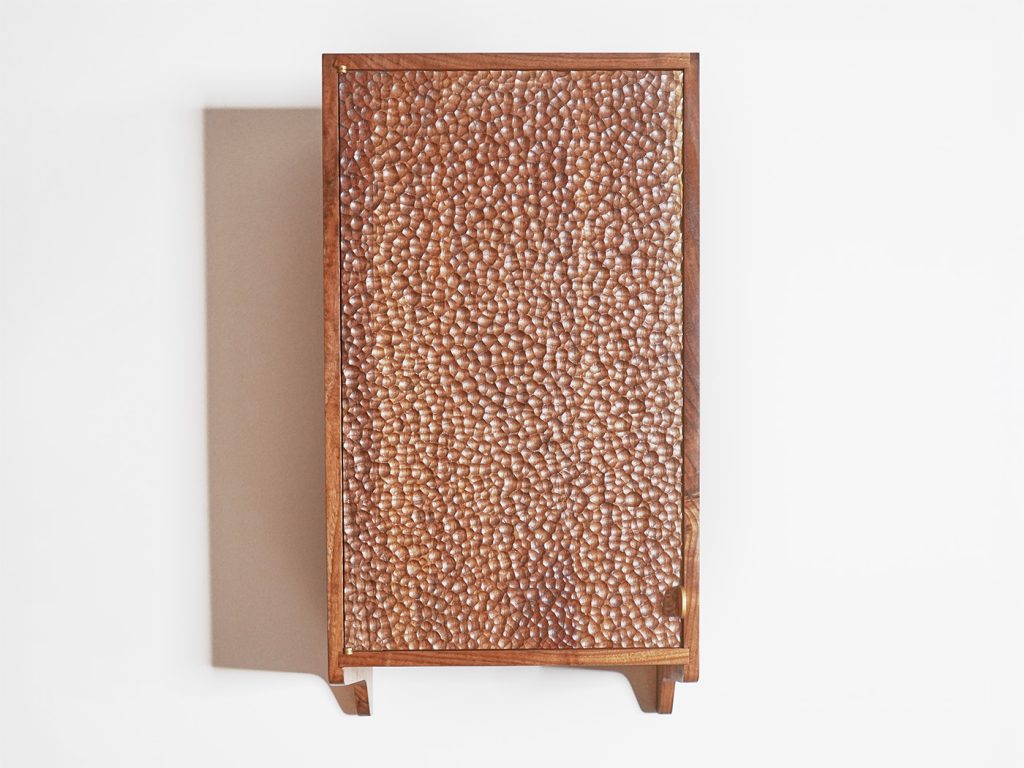
This simple cabinet is elevated by thoughtful details. When you get right down to it, a wall cabinet is basically a box with a door on it. That doesn’t mean...
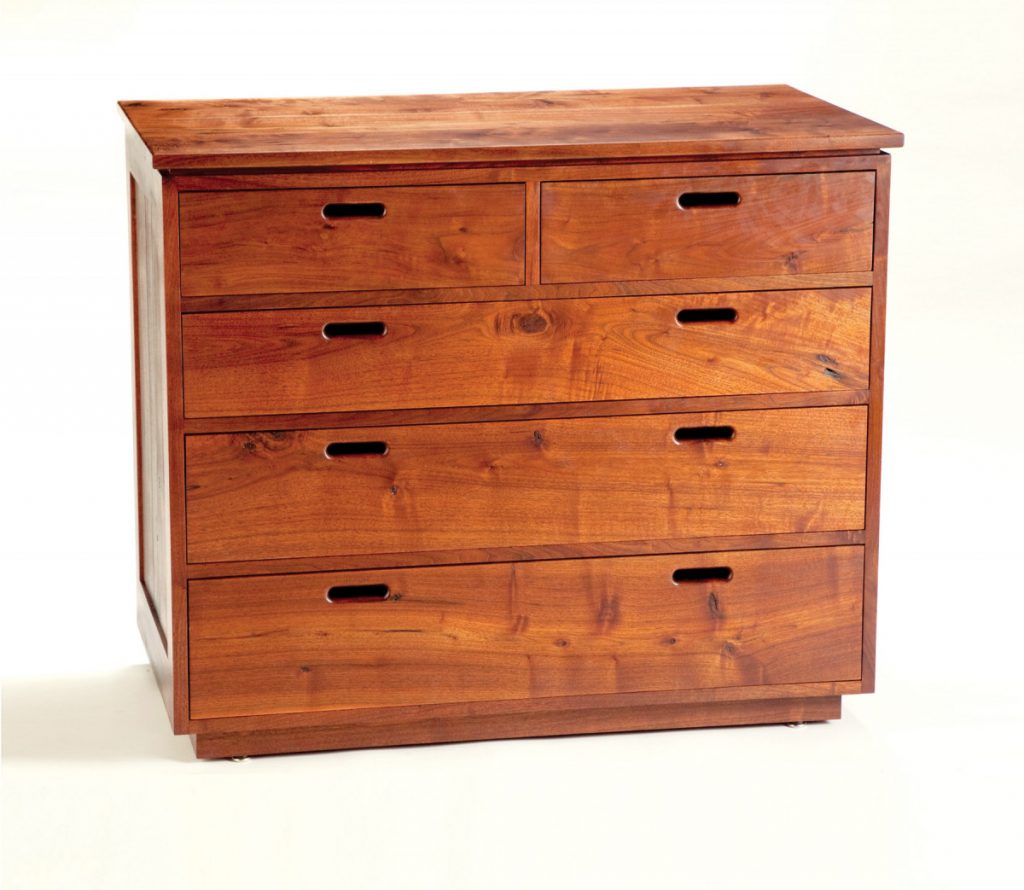
Building for the love of wood. A visit to the Design in Wood exhibition, the annual show sponsored by the San Diego Fine Woodworkers Association, inspired me to enter this chest of drawers, which I built for my daughter Christina. …
I needed a side table to put next to my favorite chair in my office/music room. I have several guitars on display, so I thought it would be cool to make a guitar shaped side table to keep the music theme going. I used my X-Carve CNC Woodworking Machine from Inventables to cut the table top and legs. Check out the video of this project below.
I'd like to thank Inventables for sponsoring this project. I used their free EASEL online software to design the project. The top is cut from a 16"x24" panel of 3/4" walnut. The legs are cut from a 9"x21" section of 9/16" thick maple. (I had to plane the maple down to 9/16" thick so that the standard tuning pegs would fit. I also made the mortises 9/16" wide to match.) Click here to open my EASEL project to see how it's designed.
The design includes the mortise and tenon joinery for gluing the legs into the table top. The CNC leaves rounded inside corners on the tenons, so those need to be sharpened up with a chisel, file or saw so the joint will fit tightly.
I purchased an inexpensive set of Guitar Tuners from CB Gitty. You will notice that one of the holes in the scaled-down guitar neck legs is larger than the others. This is to mount one of the standard size guitar tuners on each leg. I strung up a regular .042" A string between the tuners for some additional support to keep the legs from spreading apart under weight. The .056" E string would be a little stronger and more visible, but I didn't have one on hand.
This Guitar Side Table is a great addition to my office/music room. I love it and it's a great conversation piece. The walnut and maple look beautiful and I think the "stringer" at the bottom is pretty clever if I do say so myself. Thanks for checking out my project!
Clicking a referral/affiliate link in this article and making a purchase will help to support my channel via a small referral fee from the merchant. Thank you for your support!
While I wanted to wait until the project was complete before showing it, I have just finished a mammoth step, so decided to share the progress.
Starting with a slab of American Walnut
It has been resawn into two pieces, and joined together to create a slab of the required width
Then, after 24 hours of solid routing on the Torque CNC
And a quick initial application of Danish Oil (as much to find where I need to do additional sanding), the result is starting to show some promise. (The gauges are only to test fit, they will not join the project until it is pretty much complete). The top station (the celtic design within a circle) is not just decoration, it will also be a clock. The gauges are all high quality German-made ones I bought from Carbatec.
Exhausted getting this far, and I still have to have it finished by Sunday!! And tomorrow is a day away from the shed
What does it look like when three different people build three different parts of a table? It turns out looking WACKY. The guys from the Making It Podcast came together to create something fun!
Jimmy Diresta and David Picciuto and I have been recording a podcast together called Making It for the last 8 years. We have recorded several live broadcasts of Making It and the most recent being the one at Maker Faire in Louisville, KY. Since we were all going to be in town together we decided to collab and make a table. Here’s the kicker: we each made a 1/3 of the table separately.
While we were in California, the team and I brainstormed what we could do for my 1/3 of the table. We thought of everything from a colorful oil and water mixture to trying to create a something made of resin for the table top. We landed on something that I got pretty excited about – creating a plinko game.
2. My 1/3 of the Table
Starting off, I used 1/2 inch MDF that I picked up at a local hardware store and using basic geometry (can you believe Geometry in high school actually paid off?) I drew out the shape of the table top. Using a digital protractor, ruler, and a pencil I made a 120 degree angle. From there I went 12 inches out and that will give me the curve and the outside profile. The back walls of the table are being made out of 1/4 inch MDF so as I was preparing my 1/2 MDF to cut, therefore I had to make sure I accounted for the material I was going to be adding in later.
Using the jigsaw I cut out the base of the table then I used the table saw and miter saw to cut the 1/4 inch MDF for the back sections of the table. By cutting a miter into the two pieces, the corner would fit in with the other two sections of the table that Jimmy and David made. Since the table won’t be carrying a ton of weight, I used wood glue and pin nails to hold the base and back walls together. At this point, I painted it black (you already know my love for painting it black – get the t shirt here!) Josh went over to the laser to cut out the acrylic pieces.
The top and front portions were both clear acrylic in order to see the marble going through the plinko game; the interior piece was lasered with tiny holes for the 3 mm acrylic rods to stand in as the obstacles for the marble. The acrylic rods came in a pack and I needed to use the laser to cut them down to fit them into each hole. Honestly, the trickiest part was figuring out how to mount the tilting acrylic inside of the table; it had to be angled for the marble to roll but also have the clearance to roll down.
3. Putting the Pieces Together
For the front piece of acrylic, I pre-drilled holes into the MDF to attach it with screws. Next, I used one of the 3mm acrylic rods as the pivot point for the tilt – I attached that with acrylic cement and a Total Boat 4 minute epoxy to make sure it stands the test of time. Later, I 3d printed a knob to go on the end for easy manipulation of the tilt.
After getting that together, I cut down the rods to fit into the holes on the orange acrylic. Since the holes cut were every so slightly too big, I glued each rod in place for security. To mount the tilting piece I attached a small block of wood with a sanded taper on it and drive a screw to capture that back corner allowing it to pivot on that screw.
When I tested it out, I realized there were straight paths downhill with negates the game aspect. Therefore, I cut down additional acrylic walls and set them up in between random pins to force the marble to go different places – above all I wanted to make the game more fun!
4. Adding the Acrylic
For the last piece of acrylic, I drilled holes in the top for the marble to be dropped in and I attached it to the table game frame with glue to the front piece.
Attaching the acrylic top to the back walls made of 1/4 inch MDF didn’t go as smoothly. I had to drill a hole slightly bigger than the screw I used through both the acrylic and the MDF, fill that hole with CA glue and then put in the screw. I did this in order to allow the glue to harden the MDF for the screw to sink into rather than splintering up the MDF with the screw.
To finish up my part, I used a thick dowel as the leg and I used a hardware set to make a tapered leg. It came with a plate that goes on the bottom of the table, with a threaded insert and a threaded rod. I put the insert in the dowel and used that rod to connect the table to the leg. With the addition of the leg – my part is DONE!
5. Finishing the Table
Just as I predicted, David’s table was modern and slick and looked really good. Jimmy’s was filled with stuff from his shop with resin and a bent wrench for the leg. We used a Total Boat epoxy along with a circular piece of WOOD to attach the three pieces together.
When we flipped this table over it looked – interesting. It was fun to put our heads together and create something totally different. Be sure to check us out weekly on the Making It Podcast.
Tools List:
(purchasing via these affiliate links supports ILTMS)
 Login
Login







.jpg)