WoodCentral
❌

Normal view

Carved Fans: Frame for a Dancer

25 October 2025 at 21:08
Inspiration and trial piece
Lay out and starting technique

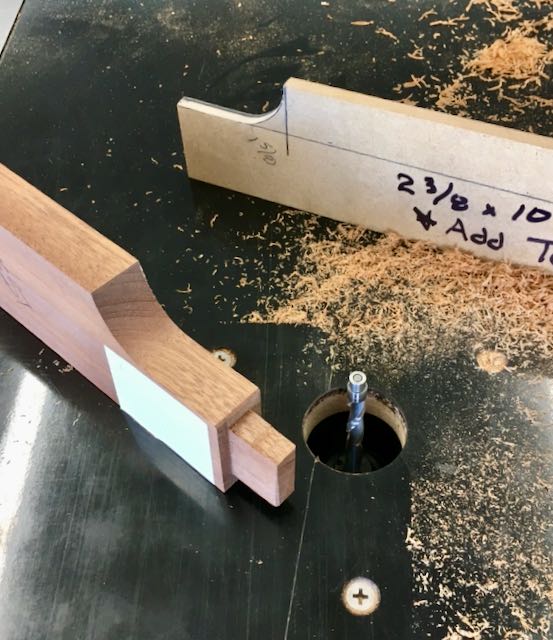
Those of you who follow my work know that I’m often inspired to create a frame when I go into Diane’s studio and see a work in progress. Well, recently I saw a dancer that she was painting and immediately thought Flamenco and visualized the fans I’ve seen Flamenco dancers use. Next thing you know I’m searching the net for pictures!! Once I found a picture of the fan to use the next hurdle was figuring out how to make a pattern and transfer that to each corner of the frame. Adding to the challenge is that the frame has a 15Β° slant to it so using a compass wasn’t an option. The frames size allowed for a circle with a 2β€³ radius so the first step was to use the Pages program and print off a couple of circles of that size, that’s the gray piece in the right photo. I’m a big fan of using plastic from lettuce containers to make my templates. The paper is attached to it with spray adhesive then cut to shape. For the circular piece in the center I used a 7/14mm gouge to not only cut the template but also the wood. The outside was carefully cut out with scissors and the location of the frame miter was marked on it as well.

Line the template up with the sight edge and the miter to draw the circle (3/4 of one actually). you need a way to divide the circumference into an even number of parts. The only way I know to do this is to use dividers , if you’re not familiar with these they’re the black tool in the right picture. Set up the dividers on paper, not your wood β€” you’ll be doing a lot of trial and error work to do this so paper is easier to erase! As a furniture maker I use them a lot to divide a given space into equal sized parts and layout dovetails. To use them you β€œguesstimate” a size you think would work, adjust the dividers to that size and then β€œstep it off” from end to the other end. The goal is for the last step off to end exactly at the end of the piece. Until it does you’ll need to make very small adjustments spreading the legs more or less until you get equal sized fan blades. Keep the dividers at that setting, you’ll need them for each corner. Note: I’ve tried to explain this the best I could but it is confusing, here is a LINK for a short article I found on the net.

Here are the tools used. After using the template to draw the outer circle and the inner circle on the wood I first used a 7/14mm gouge to outline the inner circle. Start at the sight edge and use the dividers to divide the space, I’d suggest using a pencil rather than the point of the divider as it could show in the carving. Now, use a flexible straight edge lined up with the corner of the miter to draw a line to the marks you made using the divider. See the picture, top right. This line is the high point of the fan blade.

Use dividers to find center of fan blade
Draw arrows to show direction of slope

Once your corner looks like the left hand picture it’s time to divide the fans β€” I strongly suggest only doing two blades at a time to save confusion. Measure and make a mark at the center on one blade. Use the dividers to mark the centers of all of them, you may need to eyeball and adjust if it doesn’t look quite right to your eye. The right hand picture shows the arrows drawn to remind me which way the slope goes. Here’s the order that worked for me and the tools I used for this project:

  • Use 1F/8mm skew to cut angled line from outside to middle line at the bottom of 2 blades, draw your arrows to indicate slope direction
  • Use 3F/6 to cut to desired depth at end of the blade. I also used a 2/10mm and 2/14mm to blend the carving into the rest of the frame
  • I used what I call my golf ball skew, it’s an old Marples skew fitted with a golf ball which lets me make curved or straight free hand cuts. Make a straight cut down the middle line from the inner circle to the end of the fan blade
  • The goal is to have a tapered cut that slopes to the middle line and down to the end. For me, the best tool was a 3/4β€³ very sharp bench chisel. Take very light cuts and work from both sides trying to stop your cut before hitting the other side. Definitely practice these, you can’t put the wood back!
  • You will probably need to deepen the cut at the end of the fan blade to maintain a sharp edge.
  • The grain direction changes on every cut due to the miter and to add to the challenge my profile has a 15Β° angle too.

I needed a lot of practice before I got what I considered acceptable results. The profile is about 3β€³ wide and what I call my 15Β° profile. I plowed a 1/4β€³ bead on the sight edge for a detail and also to create a definite stopping point for the fan. The tool I started with at first was a 1/16mm double bevel skew since that’s a β€œcarving chisel”. Wasn’t happy with how it worked, difficult to create that smooth slope I was after. Then tried a 3/4β€³ cabinet chisel and it gave a much smoother cut. Also easier to hold and control than the fishtail skew.

Here’s one corner of the 18β€³ x 24β€³frame freshly finished with RMP finishes milk paint in Arabian Night Black. I’ve used their product on quite a few frames and like its appearance. You can mix up a small amount so there’s very little waste. To apply it they sell quality foam brushes which leave a nice finish. I usually apply 2 coats and then smooth them out with a 2500 grit nylon pad. To seal the milk paint my preference is OSMO 3043, satin. A thin coat is applied with a chip brush and then wiped dry with blue shop towels. Don’t rub it down too hard, some of the milk paint will come off and you’ll see it on the towel! After 24 hours or so, apply another light coat and since the first coat sealed the milk paint there won’t be any transfer. I’ll post a picture of the completed frame and painting on my Instagram once they’re both dry and assembled.

  •  

Danish Loveseat: Part 3

24 June 2025 at 03:18

Backrest and Seat

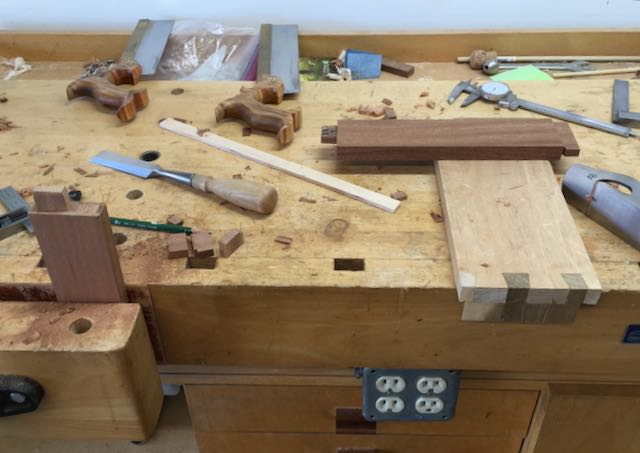
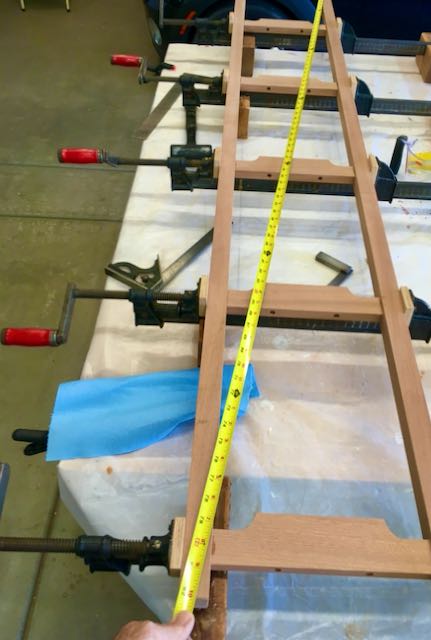
In my last post the parts and pieces were completed for the seat frame and the backrest. Since that time the slats were finished (Osmo 3043 using Mirlon abrasive pads). The top and bottom rails were finished as well but their tenons were taped off. The final step was to form the sides of the backrest with spokeshaves then glue the entire piece together and finish it completely. Before assembling that though the through mortise and tenons for the arm rests had to be fitted.

  • Trial fit for armrests
  • Backrest pieces prefinished
  • Backrest glued up β€” 6β€² Jorgensen clamps

The process for making the seat assembly was similar. It consists of two end pieces which are supported by the stretchers between the two legs. The front rail is attached with a haunched mortise and tenon joint and the back and center support use mortise and tenons as well. To accommodate the webbing from House2Home, a 1/8 slot is routed for the clips. Kind of tricky, it’s best to remove about 1/8 of material so the webbing lays flat. This was done on the tablesaw with a rip blade which requires dropping the wood onto the blade and then lifting it off β€” care required on this operation. The recess is then squared off before I assembled and finished the entire seat.

  • Haunched tenon on front rail
  • Material removed for webbing, rip blade
  • Squared off and chiseled smooth
  • Glued and clamped
  • Finished with 2β€³ webbing installed

Armrest to Leg Assembly

While designing this piece I looked at so many Danish Modern pieces on Pinterest it made my head spin! I wanted something graceful and not just a machined, routed piece. I had set aside a piece that had some interesting grain for the armrests so that determined how wide they could be. Even though they’re about 4β€² apart it’s important to me that the grain matches. The bottom has a simple, long chamfer while the top has a slight radius. Sculpting began with my old Stanley 151 and finished up with a Bogg’s style Lie-Nielsen . The antique Stanley removes material quickly without clogging while the L-N does a beautiful job of finishing. After drawing in the β€œlimit” lines of the bottom chamfer work began with the spokeshave, shaving to the lines. Once the cut was close a sliding bevel was set to make the chamfer uniform on the edges and the ends formed to match.

Beginning of end
Checking chamfer angle

The armrests are attached with wedged, through mortise and tenon joints. The method that Mike Pekovich from Fine Woodworking Magazine uses is what I prefer too. Here’s a LINK to it but you may need to be a Fine Woodworking member. He utilizes a spacer to get the width just right, this way you only need to set your marking gauge one time. Only variation I did was to use a 3/8β€³ drill on the drill press to remove the bulk of the material. He uses a smaller bit and makes more holes; either way works. I could do this because my tenon is 7/16β€³ wide. I also used this method on the Japanese toolboxes for laying out both the mortise and the tenon. I’ve been presenting my work in a slide show format to simplify the blog β€” let me know if I succeeded!

  • Lay out on tape using spacer
  • Drill press to remove bulk
  • Chisel work to scribed lines
  • 2Β° angle for outer walls
  • 4Β° wedges
  • Kerfs and relief holes
  • Assembled armrest to legs

At this point this project is almost ready for final assembly. The last thing that needs to be done is to apply the Osmo to the leg and armrest assemblies. We get our foam at Galaxy Foam and Upholstery Supply here in Las Vegas. They have foams of all densities and wrap batting around it which makes for a better cushion. Also bought the material there and unfortunately it’s too thick for Diane’s machine so they are currently being sewn at Oscars Upholstery. I’ll do a final blog on this when the cushions are done and the love seat is ready. I’ve been told my blogs can get long winded but appreciate any comments or questions you may have, thanks β€” John

  •  

Custom Family Trophy

9 November 2024 at 03:08

Recently, I received a phone call from a relative of neighbors I had in the home we moved from about 8 years ago! He remembered visiting my shop then and contacted me for a project he had in mind. They have a family tradition of wagering on the outcome of the horse racing at Del Mar. The winner is honored by having his name on the trophy and showing it off in their home. As you can see, they’ve run out of room and rather than start all over with a new plaque my challenge was to create a base that they’d be able to use for several generations. Here are the results:

Before and After

The first logical step was to get the wood needed. I sent him some links from Woodworkers Source so he could see pictures of various woods which helped but in the end we met at Woodcraft here in Las Vegas so he could see the wood β€œup close and personal”. After checking what was available he chose this piece of Ebiara Gabon which I thought would be enough for the project based on my rough plans. It was just right, I had no usable piece left so had to plan my work carefully. It’s not like you can just go down to the big box store and buy more! This is a rare wood, one I’d never even heard of or used and it worked beautifully. After planing a square edge the rough layout began using chalk.

The size of the base was determined first by the size of the name plates and then by the amount of material I had available. As I was planning the work I realized that every side of the base would be visible at some time or another so it needed to be constructed in a way that end grain would be hidden. I chose mitered edges with full masonite splines for added strength. This was assembled with Old Brown Glue, my go to for any project where I don’t want any glue to show through the finish. It’s much easier to clean up than PVA glues.

  • Splined Miter
  • Clamped with packing tape and corner clamps

The next consideration was attaching the horse from their original trophy to the new base. Two things to consider here is that depending on which side of the base is shown you may be looking at the horse’s face, side, or rear end! For that reason, I attached the horse from the bottom with a wing nut so that not only can it be rotated it is also removable which makes shipping the trophy from one winner to the other easier. Since the bolt on the horse was short a larger hole was needed to allow clearance for the wing nut. The top is rabbeted so only a 1/4β€³ of end grain is visible on two edges.

The top was glued and clamped to the base. Having never worked with this species of wood I have no idea as to how much it may move due to humidity changes so left some space. I used a simple glue rub joint on the end grain of the top allow the wood to expand with the grain if humidity affects it β€” I don’t think it will though.

Top glued/clamped to the base
Glue rub joint pieces

Making the bottom from one piece of wood presented the same problem of the edge vs. end grain and there wasn’t enough wood to do that anyway. The solution was making the bottom from 4 pieces using the same technique I use for picture frames. This way no matter how the trophy faces, the edge of the base always presents a nice, profiled piece of edge grain. It was rabbeted to accept the base and attached with screws from the bottom. There are silicone feet embedded in each corner to help anchor and protect whatever it’s sitting on.

Bottom of trophy, unfinished
Finished with silicone feet and holes for assembly

For the finish I went with what I’ve been using for many years, Osmo 3043 which is a hard wax finish. Two coats applied 24 hours apart using abrasive nylon pads followed by a coat of Liberon Black Bison wax results in a glass smooth finish. They were finished separately and joined together once dry. I couldn’t resist taking this one picture of the project assembled and finished with the horse in place and texting it to my client! All in all, this was a good challenging project β€” just what I enjoy taking on. Glad he remembered me and my shop β€” thanks!

Bottom and base finished with Osmo #3043
Completely assembled, ready for the nameplates

  •  

Sapele Display Unit

25 September 2023 at 02:37
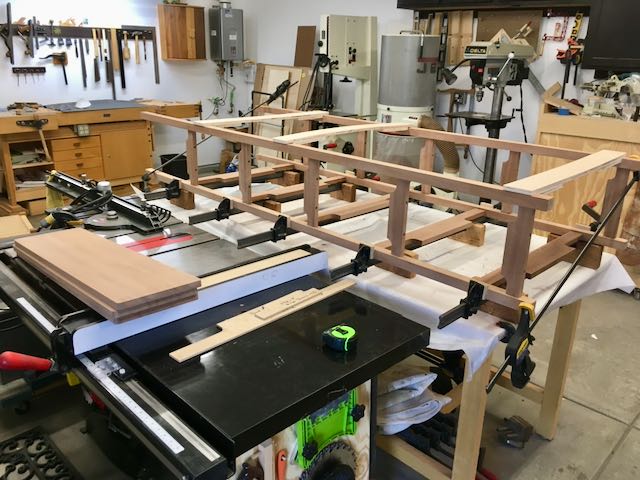
Boxes of Sepele from Woodworkers Source and the results of 40+ hours of work.

Those of you who follow my blog know I like to start with a before and after picture to introduce the project. Usually I’ll show the full size drawings I do but this goes before that β€” where I get the wood! For over 20 years I’ve been using Woodworkers Source in Phoenix and have never been disappointed. In years past I’d leave my home in Las Vegas at 3-4:00 am for the 5 hour ride there, get what I needed, and return home; nice day trip! When we lived in Phoenix (2016-2021) I was spoiled, less than 30 minutes on the road and I was there. Now with the price of gas I’ve been buying on-line and highly recommend their wood and service. I ordered what they call a UPS Pack of 7β€³ and wider Ribbon grain Sapele and the wood is beautiful.

The design evolved from inspiration off of the internet and what I had in my mind. I wanted something to anchor an area of the living room that was architectural without dominating the space. The cutouts in the shelf supports and the back piece make it appear as if the shelves are floating. I choose the Sapele to match a TV cabinet that’s on the same wall. I also like to incorporate processes I don’t use very often and in this case that was pattern routing. That was necessary to insure that each of the supports and back pieces were identical.

The first step was ripping the 6/4 Sapele to size for the uprights and locating all of the 3/8β€³ mortises required for the side pieces. This required a lot of measurement and you can bet the adage of β€œmeasure twice, cut once” was followed. I have a Jet hollow chisel mortiser which does a great job but the bottoms of the mortises do need to be cleaned up. I was careful to mark the bottom of each upright with their location to keep everything in order. Next up was to size the 10 shelf supports and cut their tenons. My technique is to first cut the tenons on the tablesaw using a tenoning jig and then fine tuning the fit with hand tools; chisels, dovetail saws, and a rabbet block plane to get a precision fit.

MDF pattern and bit from Woodpecker Tools
Set up for fitting tenons to mortises

There are 3/8β€³ holes counter bored in the bottom of each shelf support to attach the shelves with, these were plugged after assembly. The rear supports were next so very careful measuring to locate those mortises on the inside of the back uprights. The goal was to have the bottom of them even with the bottom of the shelf so that they could be screwed in from the back. Before assembly those screw holes were located and countersunk. Now that all of the mortise and tenon joints were complete the side pieces were assembled with Old Brown Glue, checked for square, and allowed to dry overnight.

All parts ready and there’s my full size drawing!
Diagonals are the same β€” must be square

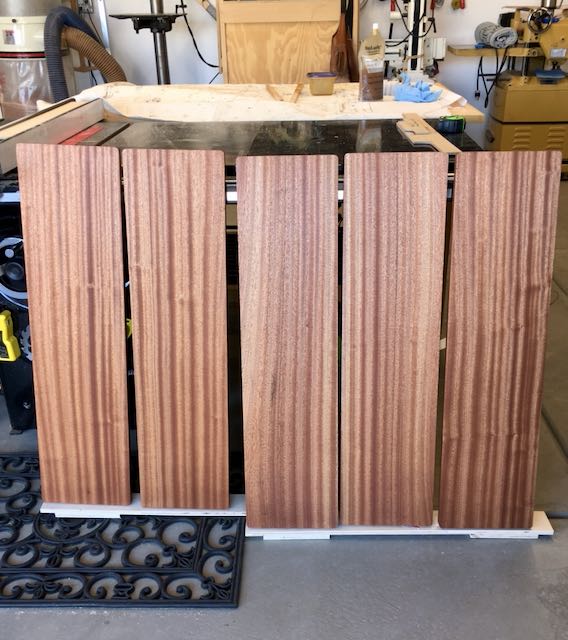
After the two sides were glued and assembled it was time to begin finishing the shelves. Planed, sanded, and a slight radius on each corner was done and then 3 coats of Osmo Polyx #3043 were applied. I use a white nylon scrubby for the application, check out the beautiful grain and finish in the photo! Between coats I also assembled the entire unit, again with Old Brown Glue which I really like because with a complicated glue up like this you need all the time you can get! In the pictures you may notice some white, plywood pieces on top, these are temporary spacers to keep the unit square since the back pieces are only attached to the back of each side. Holes were drilled and countersunk into the back piece before assembly to attach the shelves.

Shelves being finished with Osmo
Getting it together!
Maintaing square with spacer and diagonal
clamp

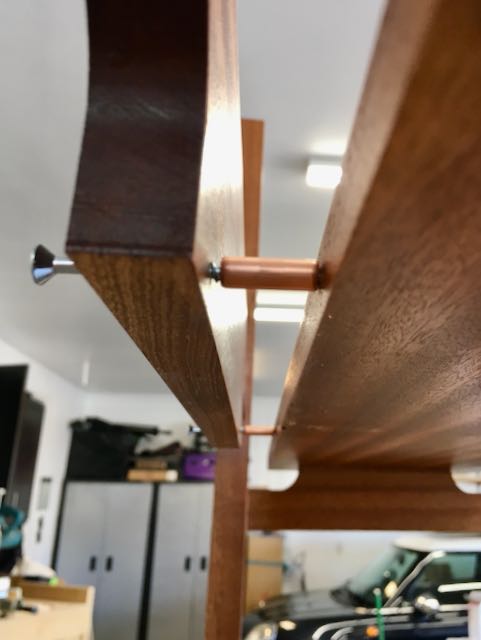
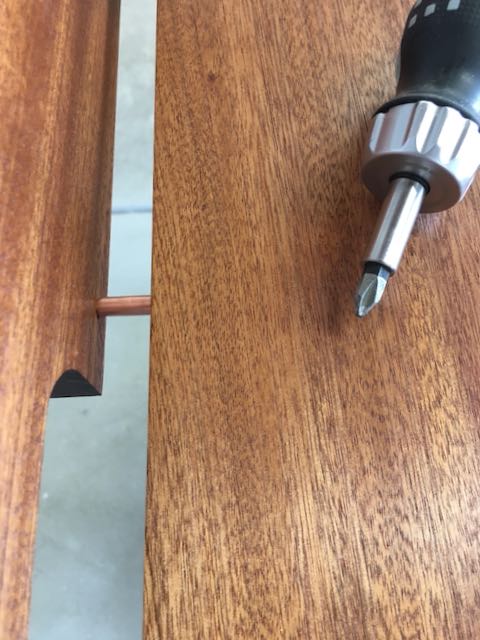
All that remained was to apply the Osmo to the entire unit which required lots of care. There are so many places that a small spot of finish could dry without being wiped off, I was very careful to check every side and intersection after applying each of the 3 coats β€” yep, found a few spots I needed to remove some build up but the results are well worth it. The shelves are attached with two screws on each side which had been counter bored for 3/8β€³ plugs. Since they were on the bottoms it was easy enough to first saw them with a zero clearance saw and then pare them flush. A bit of Osmo wiped onto the plug finished that step. I wanted to have the shelves appear to float between the supports so after locating the screw location on the back of each shelf a starter hole (about 1β€³+ deep) was drilled on the drill press to make sure it was square. I cut spacers from 1/4β€³ copper tubing to hide the screw, I think the copper gives a good accent to the Sapele.

Copper tube spacer and screw from back piece; love the gleam on the finish!!
Completed installation

Here’s a final picture of the display unit in its location. The TV cabinet is one I made a number of years ago also from Sapele. The sliding doors are Big Leaf Maple and it was finished with shellac.

  •  

Night Stands are Done β€” Final Blog

30 March 2023 at 02:05

This is a feature I really like in WordPress, as a middle school shop teacher I emphasized the magic of planning something in your head and drawing it on paper (drafting) and working with your hands to see that become an actual object. This feature brings that process to life!

All the finishing is done and the drawers are assembled. They have been screwed to their stands and the next process is installing the liner. This is a piece of 1/4β€³ x 1β€³ Basswood, mitered, painted black and then glued to the interior. Pin nails and clamps are used to install them. I taped off that area when applying shellac to the interior so the glue would stick. Pictorial process below:

Fitting in Liner
Donkey Ears used for fitting miters
Spacer block to have uniform, 1/4β€³ setback for liner

Installing the drawers is the final and critical step to this project. They are side hung on 3/4β€³ grooves cut in the sides. The stop is where the drawer face is dovetailed into them. Having the 1/4β€³ liner actually made this step easier! I know you can buy fancy jigs to install slides but I’ve always relied on a piece of 1/4β€³ MDF that goes from the bottom of the case to the bottom of the slide. This gives a solid base to put the slide on while you locate the mounting holes. To locate the holes I took a screw eye, pointed it on the drill press and reduced its size until it was a snug fit in the slide mounting hole. This was done with a sanding drum on the drill press. I used pennies as spacers to establish the gap between the drawers and the case. Again, I’ll let pictures and captions explain the process but if you have any questions about this method feel free to ask via the comment section. I didn’t put on the backs until the drawers were installed. The slides were already made and left slightly thicker than needed.

Pennies placed on liner and cut off piece in back to establish gap (1/16β€³)
After fine tuning slides, measure from bottom of unit to bottom of slide
Backs of slides planed at same time to keep drawer centered in unit
Piece of MDF cut to support slide, drawer action tested before securing the slide
Slide held tight to MDF and holes marked for drilling and screws
Process repeated but now measured from top of slide to bottom of second drawer slide, pennies between them
Second drawer in place, note penny for spacer
Process repeated for top drawer. I did both units at the same time as their dimensions were the same

After the drawers were installed the backs were attached to complete these cabinets. Bees wax was applied to the runners and grooves. I found a place in on-line that had these beautiful leather pulls and were made in the USA! They are Makeline Designs and they are beautiful! The leather is soft and I choose the aluminum discs which gleam β€” very happy with their product and quick service. I’ll leave you with one more shot of these night stands; I’m very happy with how they turned out.

  •  
❌