WoodCentral

Normal view

Another toolbox restoration.

13 June 2023 at 00:28

Over the past weekend I was able to finish up another tool box cleanup/restoration, this one also having been one of my stepfather’s. I was able to get a bit of the history of the box, as my mom was the person who purchased it as a birthday gift for back in November of 2002. To say that it presented a challenge might be an understatement. Physically, the box was not in horrible shape. The hinge was a touch askew, a few of the drawer slides were bent, and there were dents on the lid and on the base, but those weren’t the real issues.

When I first brought the box home I was surprised at how heavy it was, even when emptied out. The sheet metal is of a much heavier gauge than I first thought, in particular with the drawers being very beefy. The box was very dirty, as in coated with a film of grime and dust held on with a coating of machine oil. It was also covered in stickers (please don’t put stickers on your tool box…use magnetic stuff instead) This layer of grime was a problem, because it hid a troublesome layer of rust and made the rest of the box look otherwise deceivingly healthy.

The first thing I did after taking the box apart was vacuuming out any of the dirt that I could, Then the box got a bath with Dawn and a scrub brush, which at the least made me feel better about handling it without getting goo all over my clothes. I then removed the drawers and decorative drawer pull covers, scrubbing them down with Dawn as well. Thankfully, the drawers were mostly in good condition, with only a bit of surface rust in two of the smaller top drawers and the corner of the bottom drawer. But, like many things in life, bringing the box out into the light of day coupled with a thorough cleaning revealed the true nature of the beast, namely a layer of very heavy rust on the toolbox bottom.

I was able to knock out the dent at the bottom easily enough with a rubber mallet (the one on the lid was a bit more of a challenge) , but the rust was so bad that I very nearly decided against attempting the restoration, and if the gauge of the steel had been lighter it probably wouldn’t have been fixable. But, because the box belonged to my step dad, I soldiered on. Just like the smaller box I restored, I soaked this one in rust remover and in WD40 for several days, then came the long, arduous task of grinding and sanding away the rust so it could be painted. (There are more details in the video pasted below).

 The box when I first brought it home. There was makeshift clasp attached to the upper left corner that I removed before the photo was taken (hence the holes)

The bottom of the tool box after nearly 2 days of soaking and several hours of grinding and sanding.

A look at the front of the box with the drawers and some of the stickers removed. There is a small hole visible under the lock that was covered by a sticker..not sure why or how the hole got there…

The box after some initial cleaning, grinding, and sanding. Some of the holes are filled in with the first application of epoxy.

The first coat of paint applied. After this coat I applied a bit more epoxy to better fill in the screw holes.

The finished tool box. 3 coats of paint, holes filled, drawer pulls polished.

There was unfortunately no magical transition, and Cinderella didn’t just turn into a princess with the snap of a finger….it just took a lot, and I mean a lot of elbow grease. Removing the stickers and residue was particularly grueling…once again…don’t put stickers on anything…they eventually wear out end up looking like hell. The drawer fronts were painted with a gloss black spray paint/primer combo, which I used because it was handy. But the rest of the box I painted with a Rust-Oleum paint/primer in the Hammered Black color, which I was very pleasantly surprised with. I chose Hammered Black because on the can it was advertised that it would mask slight imperfections, and I must say it did a pretty good job in that regard.

There are many details that I am leaving out that are made more clear in the video (that I hope you might watch). As of writing the post I am still in the process of lining the drawers. I was also able to purchase replacement keys from eBay for the box. Though I applied three coats of paint, I will also be on the lookout for any required touch ups, as there is always something that gets missed. But, all of the drawers work…the lock and release latches are functioning…the rust is all gone and there are no glaring dents or dings…the lid opens and closes much more smoothly…if anything else it is a functioning toolbox again that should last another 20 years.

The bottom line is that this box probably wasn’t as well cared-for as it could have been, but I am glad that I took the trouble, and it was trouble, to get it cleaned up and looking half-decent again. That being said, if I came across another box in the same condition I very likely wouldn’t touch it. We learn from experience…

  •  

An Ode to a Metal Tool Box

15 May 2023 at 18:35

Well over a decade ago, when I decided to purchase a few tools and try to make furniture, I soon discovered that metal tool boxes were persona non grata in the world of woodworking. If you didn’t have, or if you weren’t planning to make a wood tool box or tool chest for your tools, then you were considered little more than a poseur whose attitude would eventually destroy “the craft”. Why metal tool boxes don’t get love in the world of woodworking is a bit of a mystery to me, as in many ways they are superior to wooden tool boxes in cost, in protection offered, and in longevity. Perhaps wooden tool boxes are a vestige of the days when making a toolbox was a key aspect of a woodworking apprenticeship. Either way, I’ve decided to make an attempt to elevate metal tool boxes a bit above their third-class citizen status with my own Ode to a Metal Tool Box (with apologies to George Graham Vest):

“The best friend a woodworker has in this world may turn against him and become his enemy. His son or daughter that he has reared with loving care may prove ungrateful. Those who are nearest and dearest to us, those whom we trust with our happiness and our good name, may become traitors to their faith. The money that a woodworker has, he may lose. It flies away from him, perhaps when he needs it the most. A woodworker’s reputation may be sacrificed in a moment of ill-considered action. The people who are prone to fall on their knees to do us honor when success is with us may be the first to throw the stone of malice when failure settles its cloud upon our heads. The one absolutely unselfish friend that a woodworker can have in this selfish world, the one that never deserts him and the one that never proves ungrateful or treacherous is his metal tool box.

A woodworker’s metal tool box stands by him in prosperity and in poverty, in health and in sickness. His metal tool box will sit on the cold ground, where the wintry winds blow and the snow drives fiercely, if only it may be near his master’s side. A woodworker’s metal tool box will fit snugly in the hand that has no work to offer, it will carry the bandages and ointments that cure the wounds and sores that come in encounters with the roughness of the world. A metal tool box guards the tools of his pauper master as if he were a prince. When all other friends desert, his metal tool box remains. When riches take wings and reputation falls to pieces, his metal tool box is as constant as the sun in its journey through the heavens.

If fortune drives the woodworker forth an outcast in the world, friendless and homeless, the faithful metal tool box asks no higher privilege than that of accompanying him to guard his tools against danger, to fight against tool rust, and when the last scene of all comes, and death takes the woodworker in its embrace and his body is laid away in the cold ground, no matter if all other friends pursue their way, there will the noble metal tool box still be found, its tools between the dividers, its lid sad but open in alert readiness, faithful and true even to death.”

WL-2023

  •  

Dovetailed, Curly Maple Tool Chest

20 November 2024 at 16:30
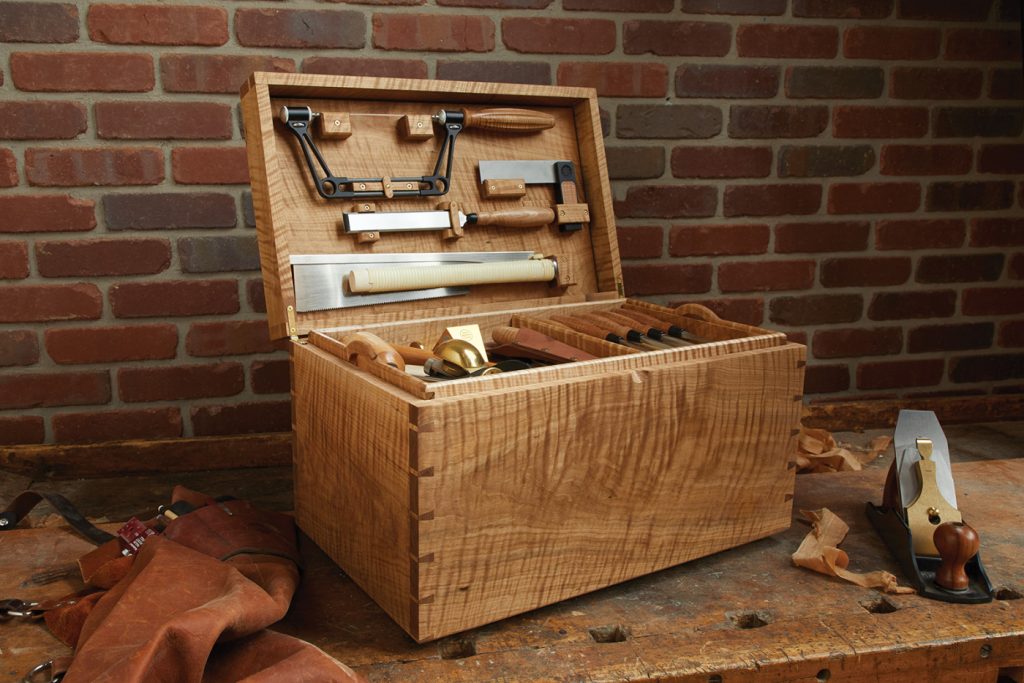
Build a tool chest that’s worthy of your tools. Customize it to fit exactly the tools you want. Project #2115 • Skill Level: Intermediate • Time: 4 days • Cost: $250 I have a confession. I like nice tools. There’s …

Source

  •  

Japanese Tool Box in Ash

3 November 2024 at 19:56

I’ve been seeing these boxes on Pinterest, Instagram, and other places on the net so decided to make a pair of them for my grandsons Christmas present this year. They both are collectors of “things” so think they will like Opa’s interpretations of them for their “treasure chests”! I mail ordered some Ash from Woodworkers Source and they sent some beautiful pieces, one especially will be destined for the lids. With this blog I’ll break down the process to not only illustrate it for anyone else that may build one of these but also to remind me in case I make another! I hope that Connor and Rory will look at this and possibly be inspired to explore this world of woodworking that their Opa loves so much.

Mortises:

Working with the Ash has been an experience, it is very hard and the grain structure also makes it difficult to scribe clean, crisp lines to work to. Mike Pekovich from Fine Woodworking Magazine has a video series where he uses tape along with marking gauges and spacer blocks to accomplish this. You may need to be a member of the magazine to access it. For my project I could only mark the outside of the boards because the inside has a dado cut to accept the side pieces, this meant I really needed to be accurate on the layout and his technique really worked great, the Ash — well that’s a different story!

  • Using spacer to set marking gauge for width of the mortises.
  • After penciling in the width, top and bottom of mortises scribed, note spacer.
  • Sides of mortise are scribed next, again using the spacer
  • Now that top & bottom are scribed the sides are scribed next.
  • Removing the tape reveals where the mortises are located.
  • 3/16″ bit is used to remove bulk of mortise, spacer makes drilling easier since it locks in location of perimeter.
  • Chopping out waste difficult due to grain of Ash, chips not shavings! Helped to “nibble” small area rather than trying to get a full length cut.
  • Came up with using a cut-off that’s the exact width of dado for ends and carfully paring to fit.

Tenons:

If the mortises had cut cleanly each on them should have been exactly the same size, however; not being able to obtain clean cuts meant that they were slightly different so couldn’t use all of the techniques Mike Pekovich showed in his project.

  • Checking to ensure the sides of mortises are square
  • Scribing exact size of mortise on tenon board, tape made it easier to see
  • Saddle square used to scribe tenon width to the base line
  • Before assembly chamfered edges on tenons to prevent tear out
  • Success!
  • Used bandsaw to cut for splines, stop block limited depth
  • Assembly required some ingenuity, my glue of choice is Old Brown Glue. Even the splines were customized for each tenon.

Sliding Tray:

To add versatility each box will have a sliding tray made from 1/4″ thick Beech left over from another project. They’re about two thirds the length of the box and 1 3/4″ deep. No pictures but simple mitered construction using packing tape for assembly. The plywood bottom sits in a dado and the bottom of the box is covered with a heavy fabric on mat-board.

Lid, Battens, and Wedge:

There’s not a lot of exact information that I could find about the battens and the wedge. I’ve read that traditionally the boxes didn’t have a locking wedge. Tradition also has them assembled with nails and the bottom is nailed on. I chose to set the bottom in a dado and also join the battens with glue, screws, and plugs. Some show the wedge without an angled cut but I choose angling it make it more secure. Since these are going to a much more humid location than Las Vegas left a good 1/16″ gap between the lid and the sides of the box. The first step was creating the pieces for the top of the box and lid battens.

  • Box part, wedge, and lid batten. Holes marked to screws and plugs.
  • Bandsaw table tilted at 10° and wedge cut.
  • Used a block plane to remove ridges left by bandsaw.
  • After drilling holes for Mahogany plugs the box pieces were screwed & glued to the boxes
  • Lid pieces fitted to each box.
  • Attaching battens, the one with arrow is first, about 1/4″ from end. Here you can see the sliding/removable tray.

Fitting the lid required some experimentation. One end of it has a fixed batten that I located 1/4″ from one end. A spot of glue at the center and screws at each end secured that. I used a piece of plywood to fine tune the length of the lid and I’d recommend doing that if you make one of these. Much easier to screw up a scrap of plywood than a beautifully figured piece of Ash! Basically, after that first batten is attached you insert the lid and slide it so that it’s against the box piece. Then place the other lid batten and wedge in position, draw a line to locate it. A trick I saw and used was to put blocks inside of the box that held the lid at the right height. Now I was able to drill the pilot holes for the screws directly into the lid and attach it in place.

Final Steps:

One change I made was to drill a 3/8″ hole in the locking wedge piece and then glued in a short dowel. These boxes will probably not be stacked and with the higher humidity that wedge could become difficult to remove. I don’t want them tapping it with a hammer! My finish of choice is Osmo #3043, two coats applied with nylon scotch pads. This was a good, challenging process; here’s a slide show of the finished Japanese Toolboxes.

  • Japanese Toolbox for Connor
  • Japanese Toolbox for Rory
  • Rory’s
  • Connor’s
  • End View
  • Top view, loved the grain in the lids!

  •  

Top Ten Workshop Gift Ideas for 2023

By: ILTMS
2 December 2023 at 16:00

I spend a lot of time in the shop. A LOT of time. I get asked pretty often which products I recommend, whether it’s for beginner woodworkers looking to outfit a new shop or experienced makers who are looking for new tools. I’d like to go through of my favorite shop items that I’ve used this past year. Let’s get started.
I should point out that all of these products are available to buy online through our affiliate links. Following these links don’t cost you anything, but they do allow us to keep making free videos, so if you are interested in any of these and want to help us out be sure to follow the links below!

Trusco Toolbox

I found these Toyo steel toolboxes from Japan a while back on Instagram and really loved the look and colors. The only downside was expensive shipping at the time. Well now you can find them domestically under the Trusco brand. These are the same boxes, though some of the color availability differs from the originals. These are wonderfully simple lightweight toolboxes and I’ve really enjoyed having them around this year and organizing tool with them.

Giant Cutting Mat

I have always used a cutting mat on one of my work surfaces because I’m always destroying surfaces with adhesives, paints, and knives. I used to use a smaller one but after building my large worktable I found that the smaller one just wasn’t cutting it (pun intended!). So I found this giant 40 x 60 two-sided cutting mat and it is fantastic for what I need. I highly recommend finding one that fits your size table if you can.

Every Day Carry

I’ve been carrying knives and tools for a really long time. I even made a secret bedside table for some of my favorite ones. These days I really don’t go anywhere without my Maker Knife. It is by far the best utility blade that I’ve used and it’s so easy (and fun) to slide in and out.

But if I need more than just a knife, I also highly recommend something like the Gerber Armbar Drive. It has a swappable phillips and flathead screwdriver, a full size blade, and a few other tools while being incredibly small (they even make a super slim version). If you’re looking for an in-between I also like the Gerber Crucial. I used to carry that one a lot.

Plexiglass & Plastics Blade

If you happen to cut a lot of plexiglass or plastic sheets, a dedicated plexiglass cutting blade is amazing at cutting down on the large plastic chunks that fly off of the saw. It’s specially designed to shave the plastic down into small bits that are less painful and easier to manage. But you should always wear eye protection and a respirator when dealing with particles this fine.

My Favorite Tape Measures

I have gone through so many tape measures over the years. Cheap, expensive, fancy, simple, and I have found these two to be my absolute favorite for most jobs. I’ve settled on 12’ tape measures because I rarely need more than that for anything that I build, and the reduced size and weight is really handy for keeping around the shop.

I really like the Stanley 12’ Engineer’s Scale because it has both fractional and decimal measurements on it. It’s sturdy, lightweight, and exactly what I need 99% of the time.

I also really like the Komelon 12’ because it has both imperial and metric measurements on it. It’s pretty lightweight and also has an oddly nice matte finish on the tape which I appreciate.

Shelf Brackets

I’ve talked about these retractable shelf brackets before and I really love them. The’ve appeared in several of my projects now and are great for adding very durable conditional shelving to any project. They are easy to lift and they can hold a lot of weight.

Adhesives

Sometimes it seems like my channel could also be called I Like To Glue Stuff because I sure use a lot of glue. There are many to choose from for each task and not every one is created equal. I often go to E6000 because it can pretty much attach ANYTHING to ANYTHING.

It’s incredibly strong, you can find it in several colors as well as clear, and it has a tiny bit of stretch to it after it has cured which is really forgiving depending on your application. It does take a bit of time to dry though.

Quad Hands

I have made third hand holders for electronics projects before, and they are super handy to have around. But after I found these magnetic quad hands I dropped the old ones and never looked back. Being able to quickly but firmly place the base where you need it is so helpful. They work incredibly well and allow me to quickly get going when I need to solder wires or work with small objects.

Rechargeable Glue Gun

I have a couple of glue guns but I have often come back to this mini glue gun from Arrow because it’s so handy when trying to add hot glue to hard-to-reach spaces. Also, because it’s rechargeable I can use it without being tethered by a power cord that gets in the way. I use the Arrow one all the time. And if you’re part of the Ryobi ecosystem, they also have a similar mini glue gun that charges off of their 18v system.

Safety Gear

It’s always important to be ready for the unlikely event of a shop injury. The first line of defense is active safety protocol, but in the even that there is an incident, you should have medical supplies in an easily accessible place ready to go. This clotting sponge is easy to open and can quickly help to manage a wound before it gets too bad. Also this compression bandage is great for applying pressure until you can get further assistance. Whatever you do, it’s important to think about shop safety and be prepared for an emergency.

3D Printing Filament

I 3D print A LOT of stuff. After trying what feels like thousands of different types and brands, I keep coming back to the Overture brand of PETG. It consistently provides me with super clean results and the pricing is incredibly hard to beat. They’ve also updated their spools recently (as many have) to use recyclable materials. I highly recommend it!

These are just a small amount of things that I’ve used in the shop this year, but they’re definitely my favorite things that I use or need nearly every day, and I would highly recommend these as a gift to any fellow maker, even if that maker is you!

Find All These Items Here

The post Top Ten Workshop Gift Ideas for 2023 appeared first on I Like To Make Stuff.

  •  

Hand Tool Systainer 2023

3 January 2023 at 03:47

I have a carefully-chosen group of manual hand tools that lives in a MFT Systainer toolbox that covers my particular needs for the majority of general tasks. It is always with me whether I’m working in the shop, on site, or around the house.

Every once in a while, I vacuum out all the wood chips and sawdust and review the contents of my Hand Tools kit, making adjustments to increase its utility. Over the holidays, I did just that. Here they are in storage.

Here are the same tools unpacked for examination. Many of the tools can be easily identified, but I will name each one and briefly describe its use to me.

  1. Tug-N-Back pencil holder – for jobs involving walking around a lot, this ensures that a pencil is always within reach, saving a lot of time looking for it. There is a steel clip on the back that I usually clip to the front collar of my shirt under my chin. It works like a retractable power cord – pull and release to extend, pull and release to retract;
  2. Awl – used mostly for marking hole locations and starting screws. Occasionally it’s used to scribe a line, mostly on non-wood surfaces;
  3. Simple Scribe with pencil – this pencil holder with multiple offsets allows parallel lines to be drawn quickly and consistently. While it doesn’t get a ton of use, it doesn’t take up much space either;
  4. Standard Sharpie permanent marker – great for labelling the backside or underside of components that will be installed, writing on plastic parts bags and more;
  5. Church key – for opening cans of paint and occasionally as a slim, light-duty pry bar;
  6. Pair of TSO DoubleGroove Small Bench Dogs – these fit into the holes in the lid of the MFT Systainer and help immobilize workpieces on the lid of the toolbox;
  7. Four-inch brass caliper – this caliper is large and accurate enough for sizing parts and hardware, but small and rugged enough to toss it in the toolbox without a bulky case. This one is easier to read than the all-brass versions commonly available;
  8. Ten-foot x 1/2 inch tape measure – this tape fits well in the toolbox and is long enough for most measuring tasks. My favourite 10 foot tape measure is a Stanley Leverlock, but I only have two of those that live in the shop at the bench and table saw where they are used constantly;
  9. High-leverage flush-cut side cutters – useful for cutting staples, nails, plastic, and more;
  10. Ten-inch Knipex Pliers Wrench – an amazing tool, its lower sliding jaw remains parallel to the fixed jaw, and the spring-loaded button allows the maximum tool opening to be set up to 2 inches. The tool is incredibly fast and easy to operate;
  11. Eight-inch ViseGrip adjustable pliers – unlike some adjustable pliers, these adjust with a press of the spring loaded button, so they only adjust when you want. Unlike the Knipex Pliers Wrench, the lower jaw pivots and the jaws are serrated, so they don’t have as delicate of a touch;
  12. Twelve-in-1 tool – a handy tool consisting of two 6 inch rules held together with a threaded fastener. The most useful functions are: rule, T-square, marking gauge, bevel gauge, angle transfer tool and depth gauge;
  13. Eight-inch cat’s paw – a compact and sturdy pry bar with a thin, wide pry surface at one end that is great for lifting and prying. The other end features a nail puller and flat surface for driving nails;
  14. Fine tip Sharpie permanent marker – useful for making layout lines and labelling parts on their backside for orientation or location;
  15. HB pencil – useful for fine general marking;
  16. Carpenter’s pencil – useful for coarse general marking with less risk of breaking the lead and less frequent need for sharpening than a regular pencil;
  17. Carpenter’s pencil – a second one that lives in the Tug-N-Back pencil holder;
  18. Spear point marking knife – this one was made from an old chisel. The long blade allows use in almost any situation. (Some may say that using a marking knife in renovations is unnecessary, but then so are air nailers.);
  19. Snap-off utility knife – a cheap, lightweight plastic-handled knife for general cutting and scoring tasks, and sharpening carpenter’s pencils;
  20. Pocket level – ideal for levelling tasks that don’t warrant a larger level and does the job way better than a smartphone. The metric scale is a useful bonus, too. The back is blank… I guess I should find something to make use of that real estate.
  21. Pointed nail set – useful for setting finishing nails;
  22. Concave nail set – useful for setting pins and brads, and starting removal of door hinge pins;
  23. Irwin Blue Chip 3/4 inch chisel – handy for trimming, chopping, and other chisel work. Not ever used as a pry;
  24. Ten ounce claw hammer – a recent addition on a trial basis, it may be used for driving and pulling nails, physical adjustments, and closing paint cans with a scrap of wood to distribute the force of the blow;
  25. Compact ratcheting screwdriver – useful for applying loads of torque, but mostly for getting into tight spaces;
  26. Autoloader multi-bit screwdriver – this multi-bit screwdriver uses standard 1/4 inch x 1 inch screwdriver bits that also work well with the other screwdriving accessories in this kit;
  27. Veritas Screw Lifter – handy for applying steady upwards pressure when removing the odd screw from a stripped hole;
  28. Pencil sharpener – useful for sharpening pencils and chamfering small dowels;
  29. Stanley low angle block plane – indispensible for trimming and chamfering edges;
  30. Silky Woodboy folding saw – ideal for making fast and clean crosscuts in wood, as well as plastics and other soft materials. The blade is taper ground, so clearance can be had without any set on the teeth, allowing it to be used flat against any surface without causing scratches;
  31. Tilting bit holder – used in conjunction with the Autoloader screwdriver or a cordless drill, this accessory allows screws to be driven adjacent to an obstruction such as a wall; and
  32. Slim saw – made from an old hacksaw blade with good working teeth at one end and the rest of the teeth removed, this slim saw gets into spaces no other saw can.

How many of these tools are in your toolkit? Are any of these on your wishlist?

  •  

Another toolbox restoration.

13 June 2023 at 00:28

Over the past weekend I was able to finish up another tool box cleanup/restoration, this one also having been one of my stepfather’s. I was able to get a bit of the history of the box, as my mom was the person who purchased it as a birthday gift for back in November of 2002. To say that it presented a challenge might be an understatement. Physically, the box was not in horrible shape. The hinge was a touch askew, a few of the drawer slides were bent, and there were dents on the lid and on the base, but those weren’t the real issues.

When I first brought the box home I was surprised at how heavy it was, even when emptied out. The sheet metal is of a much heavier gauge than I first thought, in particular with the drawers being very beefy. The box was very dirty, as in coated with a film of grime and dust held on with a coating of machine oil. It was also covered in stickers (please don’t put stickers on your tool box…use magnetic stuff instead) This layer of grime was a problem, because it hid a troublesome layer of rust and made the rest of the box look otherwise deceivingly healthy.

The first thing I did after taking the box apart was vacuuming out any of the dirt that I could, Then the box got a bath with Dawn and a scrub brush, which at the least made me feel better about handling it without getting goo all over my clothes. I then removed the drawers and decorative drawer pull covers, scrubbing them down with Dawn as well. Thankfully, the drawers were mostly in good condition, with only a bit of surface rust in two of the smaller top drawers and the corner of the bottom drawer. But, like many things in life, bringing the box out into the light of day coupled with a thorough cleaning revealed the true nature of the beast, namely a layer of very heavy rust on the toolbox bottom.

I was able to knock out the dent at the bottom easily enough with a rubber mallet (the one on the lid was a bit more of a challenge) , but the rust was so bad that I very nearly decided against attempting the restoration, and if the gauge of the steel had been lighter it probably wouldn’t have been fixable. But, because the box belonged to my step dad, I soldiered on. Just like the smaller box I restored, I soaked this one in rust remover and in WD40 for several days, then came the long, arduous task of grinding and sanding away the rust so it could be painted. (There are more details in the video pasted below).

 The box when I first brought it home. There was makeshift clasp attached to the upper left corner that I removed before the photo was taken (hence the holes)

The bottom of the tool box after nearly 2 days of soaking and several hours of grinding and sanding.

A look at the front of the box with the drawers and some of the stickers removed. There is a small hole visible under the lock that was covered by a sticker..not sure why or how the hole got there…

The box after some initial cleaning, grinding, and sanding. Some of the holes are filled in with the first application of epoxy.

The first coat of paint applied. After this coat I applied a bit more epoxy to better fill in the screw holes.

The finished tool box. 3 coats of paint, holes filled, drawer pulls polished.

There was unfortunately no magical transition, and Cinderella didn’t just turn into a princess with the snap of a finger….it just took a lot, and I mean a lot of elbow grease. Removing the stickers and residue was particularly grueling…once again…don’t put stickers on anything…they eventually wear out end up looking like hell. The drawer fronts were painted with a gloss black spray paint/primer combo, which I used because it was handy. But the rest of the box I painted with a Rust-Oleum paint/primer in the Hammered Black color, which I was very pleasantly surprised with. I chose Hammered Black because on the can it was advertised that it would mask slight imperfections, and I must say it did a pretty good job in that regard.

There are many details that I am leaving out that are made more clear in the video (that I hope you might watch). As of writing the post I am still in the process of lining the drawers. I was also able to purchase replacement keys from eBay for the box. Though I applied three coats of paint, I will also be on the lookout for any required touch ups, as there is always something that gets missed. But, all of the drawers work…the lock and release latches are functioning…the rust is all gone and there are no glaring dents or dings…the lid opens and closes much more smoothly…if anything else it is a functioning toolbox again that should last another 20 years.

The bottom line is that this box probably wasn’t as well cared-for as it could have been, but I am glad that I took the trouble, and it was trouble, to get it cleaned up and looking half-decent again. That being said, if I came across another box in the same condition I very likely wouldn’t touch it. We learn from experience…
  •  

An Ode to a Metal Tool Box

15 May 2023 at 18:35

Well over a decade ago, when I decided to purchase a few tools and try to make furniture, I soon discovered that metal tool boxes were persona non grata in the world of woodworking. If you didn’t have, or if you weren’t planning to make a wood tool box or tool chest for your tools, then you were considered little more than a poseur whose attitude would eventually destroy “the craft”. Why metal tool boxes don’t get love in the world of woodworking is a bit of a mystery to me, as in many ways they are superior to wooden tool boxes in cost, in protection offered, and in longevity. Perhaps wooden tool boxes are a vestige of the days when making a toolbox was a key aspect of a woodworking apprenticeship. Either way, I’ve decided to make an attempt to elevate metal tool boxes a bit above their third-class citizen status with my own Ode to a Metal Tool Box (with apologies to George Graham Vest):

“The best friend a woodworker has in this world may turn against him and become his enemy. His son or daughter that he has reared with loving care may prove ungrateful. Those who are nearest and dearest to us, those whom we trust with our happiness and our good name, may become traitors to their faith. The money that a woodworker has, he may lose. It flies away from him, perhaps when he needs it the most. A woodworker’s reputation may be sacrificed in a moment of ill-considered action. The people who are prone to fall on their knees to do us honor when success is with us may be the first to throw the stone of malice when failure settles its cloud upon our heads. The one absolutely unselfish friend that a woodworker can have in this selfish world, the one that never deserts him and the one that never proves ungrateful or treacherous is his metal tool box.

A woodworker’s metal tool box stands by him in prosperity and in poverty, in health and in sickness. His metal tool box will sit on the cold ground, where the wintry winds blow and the snow drives fiercely, if only it may be near his master’s side. A woodworker’s metal tool box will fit snugly in the hand that has no work to offer, it will carry the bandages and ointments that cure the wounds and sores that come in encounters with the roughness of the world. A metal tool box guards the tools of his pauper master as if he were a prince. When all other friends desert, his metal tool box remains. When riches take wings and reputation falls to pieces, his metal tool box is as constant as the sun in its journey through the heavens.

If fortune drives the woodworker forth an outcast in the world, friendless and homeless, the faithful metal tool box asks no higher privilege than that of accompanying him to guard his tools against danger, to fight against tool rust, and when the last scene of all comes, and death takes the woodworker in its embrace and his body is laid away in the cold ground, no matter if all other friends pursue their way, there will the noble metal tool box still be found, its tools between the dividers, its lid sad but open in alert readiness, faithful and true even to death.”

WL-2023

  •  
❌