When most interior designers in the Denver metro area start thinking about high-end furniture, their first instinct is to head to the Denver Design Center, also known as the Denver Design District, a sprawling showroom complex with dozens of showrooms representing hundreds of manufacturers that has been a destination for interior design since the mid-1980s. It’s packed with well-known brands located in the heart of Denver’s design community.
But what if the Denver Design Center isn’t actually the best answer for what you need?
If you’re searching for truly one-of-a-kind furniture, something built specifically for your space, your lifestyle, and your vision, there’s a compelling alternative.
Why Benham Design Concepts Might Be Exactly What You’re Looking For
Benham Design Concepts is a full-service custom furniture design and fabrication studio owned and operated by mixed-media artist and master craftsman Brian Benham. Working from his Colorado studio, Brian designs and handcrafts custom furniture and architectural elements using a stunning range of materials: wood, glass, stone, and metals, to create pieces that blur the line between fine furniture and fine art.
This isn’t a showroom. There are no sales reps, no product catalogs, and no manufacturer lead times to negotiate. It’s just Brian, his studio, and your vision.
Here’s Why You Might Choose Benham Over The Denver Design Center
1. It’s Genuinely Custom — Not Just “Customizable.”
The Denver Design Center excels at what it does: offering a curated range of product lines. But at the end of the day, you are still choosing from what exists, what all the other interior designers pick from. The same old, same old pieces you have shown a dozen clients before this one. You might be able to select a fabric or a stain sample, but the fundamental design is already set.
At Benham Design Concepts, every single piece starts from scratch, or rather, a concept. Brian works with you from the very first concept, designing furniture that fits your exact space, your exact needs, and your exact aesthetic. Nothing is pulled from a catalog. Nothing has been built before. Your piece is yours alone.
2. Your Furniture Becomes a Work of Art
Brian approaches every project as both a craftsman and an artist. The pieces he produces aren’t simply functional; they are visually striking objects that add genuine character and artistry to a room. Whether it’s a dining table that incorporates live-edge wood and hand-forged metal, or a media console that unexpectedly combines stone and glass, Benham’s pieces command attention.
If you want furniture that guests will ask about, this is where you find it.
3. You Work Directly With the Maker
One of the most underappreciated aspects of commissioning from Benham Design Concepts is the relationship. At a design center showroom, your point of contact is a sales representative working on behalf of a manufacturer located somewhere else entirely. The person selling you the piece has never touched it.
With Brian Benham, you are working directly with the hands that will build your furniture, from the first sketch to the final delivery. That kind of direct creative collaboration is rare, and it shows in the results.
4. Unmatched Design Flexibility
Large showrooms and manufacturers operate within constraints, product lines, standard sizing, and available materials. Brian operates within almost none of those constraints. Need a dining table that fits an unusual room? A built-in architectural element that no off-the-shelf product can accommodate? A piece that combines materials in a way you’ve never seen done before? Brian can design and build it.
That level of flexibility isn’t available through a traditional design center experience.
5. A Collaborative, Transparent Process
Brian presents every design with detailed sketches and 3D renderings before a single piece of material is cut. You can see exactly how your furniture will look and feel in your space, and you can give feedback to refine the design before fabrication begins. It’s a genuinely collaborative process, not a transaction.
6. Old-World Craftsmanship Meets Modern Precision
Brian has spent decades mastering his craft, combining traditional hand-cut joinery techniques with modern CNC and laser fabrication technology. A hybrid method that gives him a lot of creative freedom in his designs. The result is furniture with the soul of a handmade and the precision of contemporary manufacturing. It’s the best of both worlds, and it’s evident in the quality of every finished piece.
7. Local, Handcrafted, and Built to Last
Every piece of furniture from Benham Design Concepts is designed and fabricated in-house in Brian’s Colorado studio. There are no overseas factories, no assembly-required flat packs, and no corners cut. When your furniture arrives, it is complete, it is beautiful, and it is built to be passed down.
So, Who Is Benham Design Concepts Right For?
Benham is the right choice if:
You want a piece of furniture that no one else in the world owns
You have a specific vision that off-the-shelf products can’t satisfy
You value a direct, personal relationship with the craftsman building your furniture
You see furniture as an investment in both function and art
You want something that will be a conversation piece for years to come
The Denver Design Center is a resource, and it serves an important role in Colorado’s design community. But if what you’re truly after is something unique, personal, and extraordinary, Benham Design Concepts is in a category of its own.
Ready to Commission Something Remarkable?
Brian Benham works with homeowners, interior designers, and architects throughout the Denver and Colorado Springs metro areas, and ships custom pieces all across the United States.
Visit benhamdesignconcepts.com to explore his portfolio, learn about the design process, and take the first step toward owning a piece of furniture that is genuinely, unmistakably yours.
True perfection is unattainable, but if you chase perfection you will catch excellence!
Vince Lombardi
In previous articles in this series about a craftsman-made gennou hammer handle, we discussed how to design and make a handle to fit Beloved Customer’s body and way of working. This article assumes you’ve mostly completed your handle, attached the head, and are now ready to test it. So let’s get started.
Why Testing Matters
I don’t know about you, but after all the research, design and fabrication work we’ve invested in your gennou handle, I need to see how it performs and determine if its performance is superior to a Minion impaled on a stick. Being a Beloved Customer and therefore highly intelligent, you’ve asked yourself the following three indubitably perspicacious questions about testing.
What can I learn from testing?
Against what performance standards should I compare my most excellent new hammer handle (besides to a Minion on a stick)?
How should I conduct that evaluation?
To perfect your hammer, you will need the answers to these questions and more. You can get them over years of use, or get many of them now by testing it in a methodical manner and paying attention, but one way or another, you must get answers, bro.
Desired Testing Results
We can learn several things from testing our gennou with its new handle, but I encourage you to do your best to ascertain the following two things at minimum.
The first thing, of course, is whether or not the hammer with its new handle is comfortable and stable to use, and if possible, what needs to be improved to make it more stable and comfortable. This may entail many small details depending on your requirements and powers of perception.
Whether it’s comfortable in-use or not is subjective and entirely up to you, but you can probably identify problems easily through this testing process. Pain, soreness and blisters and the lack thereof are solid indicators (ツ).
Whether or not it’s stable in use is another important thing to determine early. Does it tend to track straight on the downstroke, or does it want to twist off your intended path of travel striking chisel handle or nail head erratically? When it hits the chisel or nail, does it convey its energy into the target smoothly, or does it wiggle like an eel on a hook on impact?
An unstable head and handle combination may perform well for one or two consecutive strikes, but because Murphy’s Law of Buttered Toast irrevocably dictates that small errors accumulate to maximize damage, an unstable head will often wiggle off-line enough for the third swing to hit weakly, even miss entirely, ruining your rhythm, damaging your confidence, and eliciting snide looks from resident bench cats. Oh, the shame…
A second thing you need to learn is whether or not the face of the hammer is striking the chisel/nail squarely and if the center of mass of the head is aligned with the vertical axis of the chisel handle or nail. Please make sure you understand the meaning of the previous sentence.
With this experience and the answers to these questions under your belt, you will be in a position to adjust the handle to perform its best for you and the way you work.
Testing Procedures
Out of an abundance of well-deserved humility combined with a strong desire to avoid looking even more the fool, your humble servant will refrain from suggesting any specific objective tests, or urge you to use quantifiable standards, or seek concrete empirical results because that would be too silly to even contemplate. Unless, of course, Beloved Customer will conduct these tests in your super-secret laboratory, possibly located at the heart of a dormant volcano on an uncharted South Pacific island, maybe covered by coconut palms with cold beer taps, probably surrounded by hundreds of horny bikini babes, likely frolicking in crystal surf. BTW, if you do have such a lab, please text me the address!
In this super-secret lab you will probably have access to equipment and software suited to more scientific, empirical, replicable methods of comparison, such as those developed for analyzing and improving the apparent performance, marketability and profitability of mass-produced sports equipment such as baseball bats, golf clubs, and green dildos (シ). Sadly, while your humble servant does not possess such equipment, most (but not all) humans own and operate one of the world’s most refined super-computers and sensor networks: our bodies and brains. I therefore propose you focus these formidable tools on this analysis. (brains and bodies, that is, not dildos).
Below are four absolutely subjective tests only you can perform, the results of which only you can evaluate.
Incorporating Test Results
To thwart the confusion promulgated by Murphy and his multitudinous malevolent minions, I strongly recommend you use the results of your analysis to guide you in making incremental improvements to your handle over time rather than large changes immediately, so to that end, please plan to remake your handle, once, twice or even thrice, improving it a little each time. Such is the true path of the craftsman.
Please update your handle drawing each time to record the improvements you’ve made and ensure no “increments” are misplaced.
In scobe veritas. (“In sawdust, truth”).
The Grip
As you are aware, for any testing other than drinking beer or women choosing wall paint color to be meaningful, some basic techniques must be established and followed to reduce variables to a manageable degree. How you hold the gennou handle to be tested is just such a basic technique.
The handle design presented in this series of scribbles is intended to work best when gripped in a particular way, so when performing the following tests, it’s important that you grip the hammer correctly thereby removing one huge, often-problematic variable.
Of course, I’m describing a particular grip here as being “correct,” but that’s just my well-informed opinion. In any case, I promise your hammer will work more efficiently if you abandon the so-called “hammer grip” (what I call the “Hobbit-killer” grip with the handle grasped in your fist) right away and switch to this more advanced grip.
I didn’t invent this grip, BTW, but observed and consulted with craftsman I respected in the USA and Japan who used it for many decades, all of whom are now working overtime in the big lumberyard in the sky. I later came to call it the “Sam Snead grip,” after the extremely successful pro-golfer of the same name who made it famous, and him rich, in tournaments and in dozens of books he wrote on the subject of using golf clubs skillfully.
We’ve talked about this grip in some detail in Part 13 of this series, but please review the photos below to confirm your understanding.
The first photo labeled “Bridging the Palm” shows how the hammer’s handle is NOT held in a fist, but is angled diagonally across the palm, supported on the first joint in the index finger, as well as the heel of the palm.
You can see how the index finger wraps around the handle while the thumb is pressed against the side so that the handle is strongly clamped between index finger and thumb, but can still pivot the handle if the operator so desires. This grip affords the joints of the forefinger and thumb, digits accustomed to fine motor control (unlike the fist), absolute control over three critical surfaces of the handle.
This grip also provides better control, more power, and greater reach without forcing the wrist to do the strange, unnatural contortions the Hobbit Killer grip does.
Bridging the palmIndex finger wrapped around the handle with the tip pressing against the rounded front edge of the handle.Handle pressed between tip of the thumb and first joint of the index finger. The tip of the index finger presses against the rounded front edge of the handle, and applies most of the force required to return the handle to battery.Notice how the handle is pressed between the pad of the thumb and the side of the index finger in the famous “Sam Snead” grip.
The Three Tests
Following are three tests to help you ascertain how well your new gennou and its handle suits your body and your work style.
Before attempting these tests, however, it is important to use your new handle for a time to establish a connection between it, your hand, and your eye (using the proper grip, of course).
Besides moral virtue and a sense of humor, you will need a few things.
A wood chisel suitable for cutting a mortise hole, around 24mm.
A piece of light-colored scrap wood for cutting a test mortise hole;
A stick of light-colored wood approximately the size and shape of the handle of the chisel you would normally use for cutting mortise holes:
An ink pad, wide-tip marking pen, or Dykem.
A lab assistant. I recommend a buxom, young lass with a cute giggle wearing a sexy lycra lab uniform (Warning: bad stuff may happen if you let She Who Must Be Obeyed meet, or even see, this assistant!)
So, now that we have our supercomputer and its sensor suite warmed up and focused, our tools laid out, and a bubbly lab assistant standing by, sound the trumpets and let the testing begin! We who are about to dye salute you!
Test No. 1: The Blind Retrieval Test
After you have used your gennou with its new handle for a few weeks such that your hand has become accustomed to it, please give your bench dogs a few treats, shoo away any arrogant bench cats, set it on your de-cluttered bench, step back a few steps, close your eyes and turn in-place once or twice like a ballerina with hairy legs. Now, have your lab assistant, perhaps a child, a friend, a neighbor, your girlfriend, or wife, or even a clever bench dog (but never your neighbor’s girlfriend’s wife’s cat!) change the gennou’s orientation on your benchtop by turning it over, switching it end for end a few times, spinning it, or whatever. Random orientation is what’s needed.
Next, with your eyes still closed, grab the gennou with your hammer hand in a correct grip ready to rock-n-roll. Notice how easy or difficult it is to grip the handle correctly, without fumbling and without opening your eyes. If it’s not easy to do, however, you need to know it now. It may be simply that you’re not accustomed to your hammer, or that the geometry or details are out-of-wack.
By “correctly” in the previous paragraph, I mean (1) the flat striking face of the head is facing away from you and toward the chisel or nail; (2) the handle and head are aligned straight in your hand, and not twisted, (3) the heel of your hand is pressing against the flat spot on the back edge of the handle adjacent the butt; (4) the distance from the center point of the face to the heel of your hand is located precisely the distance shown in your design drawing.
BTW, whether you picked up the habit from your daddy or some internet guru, choking-up on the grip is an inefficiency you should discard simply because it’s counterproductive and silly, like a powerful cane corso dog wearing flower brocade.
If the grip area of your handle is shaped as shown in the drawing with a flat back edge and sides perpendicular to it, a radiused front edge, and flared toward the butt, it should be easy to instantly grip the handle in precisely the proper place, with the intended striking face oriented properly, without opening your eyes and without any fumbling whatsoever.
If, on the other hand (the one with six fingers (ツ)), your hammer doesn’t leap into your hand in perfect alignment without argument or eyeball action, some adjustments to the handle are called for.
For example, a frequent cause of confusion between handle and hand is the leading edge of the grip being square instead of rounded. Or the sides and butt of the handle being angled wrong. These details can all be adjusted once you know they need to be adjusted
A gennou that naturally orients itself in your hand with the striking face in the right direction, the same distance from the striking face first time every time without your having to look at it, will provide you a tremendous advantage in speed, efficiency and confidence. It will become a good friend and companion.
BTW, just for gits and shiggles, try this test with any name-brand one-size-fits nobody nail bender you have laying around. The virtues of your new handle will become immediately apparent.
Test No. 2: The Blind Swing Test
This test will teach you something about handle length and other details.
Once again, perform this test after you have used the gennou with its new handle for some time and have become accustomed to it. A sexy lab assistant (one who doesn’t talk too much) in slinky woodworking togs is optional (ツ).
Grip the gennou properly in one hand and the stick shaped like your chisel handle in the other just as you would an actual chisel. But instead of placing the end of the stick against something as if you might cut it, please keep the stick in the air without butting it against anything. Now, with your eyes still closed, swing the gennou at the end of the stick of wood.
You should be able to strike the stick with the flat end of the gennou solidly and squarely on the first, or perhaps second try. Success in this test is common.
If your hammer misses the stick consistently, it may be because you aren’t yet accustomed to the handle, or it may be that you are choking-up up on the grip, or it may be you need to make it shorter or longer, or the grip shape needs to be adjusted. Or it may be that Murphy keeps distracting you by sending dickpics. It’s absolutely worth figuring out.
Once again, if you consistently miss the target, pay attention to why and where you are missing. Is the handle too long? Is it too short? Are you missing off to the side? Make notes recording the results and your observations on the design drawings to incorporate into your Mark II handle.
If accuracy can be improved by shortening the handle or modifying the grip, go ahead and make the necessary changes a little at a time. It’s easy to shorten the handle, but lengthening one requires an ACME Wood Stretcher Mark 2. I can lend you mine if you don’t have one (ツ)
Test No. 3: The Ink Test
Never fear: this test has nothing to do with gossip screeds or Rorschach drawings. It will help you determine if the handle of your gennou is the right length, if it is cocked at the most effective angle, and whether or not it should be canted to the left or right, and all without pulping an innocent tree.
This test works best if preformed after the Blind Retrieval Test and Blind Swing Test.
Begin by coloring the striking face of your gennou with an ink pad or by applying dark marking pen ink or Dykem to the gennou’s striking face (the flat face). Clean or sand the end of your chisel’s handle to produce a clean, white surface. Then cut a mortise using this gennou in the same posture you assume when cutting most of your mortises.
For instance, if you mostly cut mortises in wood located at a constant height on your workbench, such as drawers and furniture parts, you should employ that position. Or, if you tend to cut mortises in timbers while sitting on or straddling them using the venerable butt-clamp, please assume that position.
The impact with the chisel’s handle will wipe ink off the face of hammer and deposit it on the end of the chisel’s handle at the same time. This ink transfer will print the story you need to read. Check the ink on the gennou’s face and the end of the chisel every two strikes.
This is a time-tested technique professional golfers use to select/design golf clubs, BTW.
If the ink at the center of the striking face is scrubbed clean first, and the center of the chisel handle becomes inked first, then you have made your handle the right length with the head angled correctly. If not, you should make notes describing the results in the handle drawing you made earlier, and adjust the design of your next handle accordingly.
Again, you may find it enlightening to perform this same test with conventional hammer with a standard handle.
When your done testing, be sure to record your conclusions. Either erase and adjust the drawing, or trace over it to make and date a new drawing with your revised details. Tracing paper is our friend.
In either case, be sure to add a date and/or revision number to the drawing to ensure you don’t confuse it with older, superseded drawings. Don’t put this off but do it right away before you forget. This applies to all the tests described herein.
Adjustments to Your Handle
You should use the results of these tests to make small, incremental adjustments to your handle, as you deem necessary, rather than big, drastic changes.
For instance, you may need to shorten the handle. This is easily done if your handle is a little long and you’ve made the neck as I recommended. Worst case, make notes, adjust the drawing and remake the handle with as few changes as possible to avoid confusing over-complication.
A common correction you may want to try is, after becoming accustomed to using the hammer, to reshape the grip area to distribute pressure more evenly over the hand, and to reduce stresses induced in skin, muscle, tendons and bones by easing edges and corners while maintaining control and indexing. Most importantly, you should shape the handle so it doesn’t twist in your hand stretching your skin in uncomfortable ways, a common cause of blisters, especially in plastic-handled one-size-fits-nobody hardware store hammers.
If I may share an example from my experience, every new hammer handle I make tends to produce a blister on the first joint of my right hand index finger. Obviously a lot of pressure focus on this location on my hand. So I know to smooth the transition from back edge to the side just where this joint bears to avoid blisters.
This modification creates an obvious dent in the smooth lines of my handles, but your humble servant is resigned to sacrificing beauty for performance when necessary. Just look at the sorry state of my career as a fashion supermodel if you doubt my dedication to performance.
Another less-common problem is the hammer’s face striking the chisel handle or nail head at an angle instead of being centered on, and at a 90˚ angle to, the long axis of the chisel handle. The ink test will reveal such impish behavior.
This tendency usually improves with practice, but you can adjust for it by making a new handle with the head skewed to the left or right as necessary.
As a way to determine how much skew is required, you can plane down the sides of your test handle, glue on slips of wood, shape them as you see fit, and test the results. Once you’ve determined how much total correction is necessary, you can remake your final working handle accordingly.
Once again, work patiently to achieve small, incremental improvements, and be sure to record the results on your drawings.
Don’t hesitate to methodically scrape, shave and experiment with this first handle.
The design of this handle, and the process your humble servant has described for making it, is suited not just for Japanese gennou hammers but for all short-handled hammers and axes. Give it a try and you’ll see what I mean.
In the next article of this series we’ll apply a protective, and maybe even tastefully elegant, finish. Please remind me to call Ramon and beg him cater the unveiling party! I simply love his cheesy shrimps on crackers, don’t you?
If you have questions or would like to learn more about our tools, please use the questions form located immediately below. To see a list of our tools and their pricing, please click the “Pricelist” link here or at the top of this page. To contact us please use the Contact form below or email us directly at [email protected].
Please share your insights and comments with all Gentle Readers in the form located further below labeled “Leave a Reply.”
We see data miners and their bilious bots as dastardly sneak thieves and so promise to never share, sell or profitably “misplace” your information for any reason. If I lie may the heads of all my hammers fly away to Valinor!
Brother Saint Martin and the Three Trolls by John Bauer. Supernatural creatures are everywhere, if you have eyes to see.
I found myself in this stunning box canyon with my wife, celebrating two decades of marriage, lured by the rich history and the timeless allure of old buildings. Ouray, Colorado, named after the esteemed Ute leader, Chief Ouray, certainly lived up to its reputation. The Victorian-era structures, born from the silver and gold rush of the 1870s, stand proudly as elegant reminders of a tougher, more ambitious era.
However, I soon realized that the town’s current vibe beats to a different, more monotonous tune. As we strolled from one gift shop to another, a disheartening pattern began to unfold. The same coffee mugs, the same pocket knives, the same bumper stickers—all mass-produced, all stamped with the town’s name, and I’d bet they all came from a factory far removed from the Colorado Rockies.
It seems the traveling salesman has swapped his sample case for a broadband connection, peddling the same generic souvenirs to every historic spot from coast to coast. As an artist, this uniformity feels like a creative dead end. I travel in search of inspiration, hoping to discover art that springs from local culture and ignites my own creativity. Instead, I found innovative ideas buried under a pile of future landfill waste, akin to a fleeting TikTok trend—quickly consumed and easily forgotten.
Yet, it was this very letdown that sharpened my perspective. With my interest in the shops’ offerings fading, I began to truly appreciate the buildings that housed them. My artist’s eye turned into that of a detective, revealing a much richer story within the architecture itself.
I started tracing the ghostly outlines of past technologies: a boarded-up coal chute on the side of a brick wall, a remnant from when heat was shoveled in by the ton. I was fascinated by the hidden challenge of updating these historic structures with modern amenities. How did they weave plumbing and electrical systems through these old bones? Some solutions were cleverly concealed, showcasing the skillful craftsmanship that went into preserving the past.
The New Artisans: Where Furniture Becomes Functional Sculpture
Gone are the days when custom furniture was simply about choosing a wood stain or an upholstery fabric. A new wave of designers is redefining the craft, merging cutting-edge technology, radical material science, and reimagined artisanal techniques to create pieces that are as intellectually compelling as they are beautiful. This is no longer just about creating a place to sit; it’s about crafting an experience, telling a story, and pushing the boundaries of what is possible. The result is a world where furniture becomes functional art.
Furniture design that blends art and functionality
Here’s a look at the innovative techniques blurring the lines between art and function.
Parametric Design: This is a process, not just a style. Designers set parameters like light, stress points, or ergonomic data, and algorithms generate thousands of complex, organic iterations. The artistry emerges from the process itself.
In Practice: A bookshelf isn’t just designed; it’s grown by an algorithm that clusters shelves more densely where greater support is needed, resulting in a wave-like structure that is inherently strong and visually stunning. A chair’s lattice backrest can be parametrically tuned to provide variable flexibility based on the body’s heat map, marrying perfect ergonomics with a mesmerizing pattern.
3D Printing (Additive Manufacturing): Moving far beyond prototyping, large-format 3D printing is now used with recycled plastics, bio-resins, and metals. This technology liberates design from the constraints of traditional manufacturing.
In Practice: Imagine a chair printed as a single, continuous web that conforms to your body, or a light fixture printed with a gradient density that casts intricate, dappled shadows. This method also enables true mass customization, allowing each piece to be uniquely tailored without the exorbitant cost of retooling.
CNC Kerf Bending: A technique of brilliant simplicity, a CNC router cuts a precise pattern of closely spaced lines (kerfs) into a sheet of plywood, allowing the rigid panel to bend into fluid, graceful curves.
In Practice: The kerf pattern itself becomes the decoration, resembling everything from fish scales to topographic maps. This allows for the creation of ergonomic rocking chairs or flowing room dividers from a single, flat sheet, where the aesthetic is a direct result of the functional transformation.
Material Alchemy: The Medium is the Message
For these modern artisans, the material itself is a primary source of innovation, often becoming the central narrative of the piece.
Resin & Hybrid Compositions: While “river tables” have popularized epoxy resin, pioneers are pushing further by embedding textiles, dried botanicals, or recycled objects.
In Practice: A console table might feature a river of resin containing layers of suspended silk, creating an ethereal, deep-water effect. The resin functionally stabilizes and levels, while artistically, it “freezes” a moment in time, making each piece a unique artifact.
Bio-Fabrication: This is the true cutting edge, employing living systems to “grow” furniture. It’s a profound shift from making to cultivating.
In Practice: Mycelium (the root structure of mushrooms) is grown into molds to form lightweight, compostable stools. In another method, trees are gently guided over years to grow into a chair shape. The resulting piece is a collaboration with nature—a functional sculpture that is fully biodegradable.
Reactive & Smart Materials: This category introduces a fourth dimension: time and interaction. Materials are chosen for their ability to change in response to their environment.
In Practice: A dining table treated with a thermochromic finish reveals a hidden pattern where warm plates are placed. A cabinet door with smart glass film can transition from transparent to opaque with a switch, seamlessly converting a display case into closed storage. The furniture becomes dynamic and responsive.
The Artisan, Reborn
Tradition is not being discarded but is being re-contextualized. Age-old crafts are being applied in unexpected scales and contexts, infusing modern pieces with soul and heritage.
Textile as Structure: Techniques like weaving, tufting, and macramé are breaking free from their role as mere upholstery to become the primary structural or visual element.
In Practice: A chair’s back is a large, hand-tufted wool panel, serving as both a shock-absorbent support and a bold, textural artwork. A room divider made of tensioned, woven cords creates a soft, semi-transparent barrier that functions as a fiber-art painting.
In Practice: A kitchen island with a charred base is not only a dramatic, sculptural centerpiece but is also incredibly resilient to moisture and scratches. Artists selectively sand the charred surface to reveal contrasting wood grain, creating depth and pattern.
Metal Marbling: Borrowed from the art of blade-smithing, this involves forge-welding different metals, then manipulating and etching them to reveal organic, flowing patterns.
In Practice: The resulting metal, with patterns reminiscent of wood grain or stone, is used for table legs or entire tops. Each piece is a one-of-a-kind, durable surface that tells a story of its fiery creation.
The Common Thread: Inseparable Form and Function
What unites these diverse techniques is a core philosophical shift: the end form is not merely a decorated function. Instead, the art emerges directly from the function, the material properties, or the fabrication process. The strength of a parametrically designed leg is its beauty. The flexibility of a kerf-bent panel is its pattern. The story of a resin table is captured in its depths.
This holistic approach—where every aesthetic choice is rooted in a functional purpose—is what separates a fleeting trend from a timeless piece of functional art. In the hands of today’s innovators, furniture is no longer just something you use; it’s something you experience, a dialogue between the furniture maker, material, and user.
The Philosophical Backdrop: The Arts and Crafts Movement
To understand the chest, you must first understand the movement that spawned it. In late 19th-century Britain, thinkers like John Ruskin and William Morris revolted against the Industrial Revolution. They believed:
Machinery dehumanized labor: Factory work was alienating and soul-crushing for the worker.
Victorian design was decadent: The era was known for overly ornate, mass-produced, and often poorly made goods that prioritized showiness over function.
“Truth to Materials”: A craftsman should work in harmony with the material, allowing its natural qualities to show. A joint should be visible and celebrated, not hidden.
This philosophy crossed the Atlantic and found a fertile home in the United States.
The American Catalyst: Gustav Stickley
While several designers worked in this new style, Gustav Stickley was its most influential evangelist. After a trip to Europe, where he was inspired by the British Arts and Crafts leaders, he completely reinvented his furniture business.
In 1901, he launched his magazine, The Craftsman, which became the bible of the American movement. In its pages, he laid out his philosophy for what he called “Craftsman” or “Mission” furniture (the latter name was a marketing term, suggesting a connection to the simple, honest furniture of early Spanish missions in California).
The Design Philosophy Applied to the Blanket Chest
The blanket chest was a perfect form for Stickley’s ideals. It was utilitarian, common in almost every home for storing linens and blankets. By reimagining it, he could demonstrate his principles clearly:
Simplicity and Rectilinearity: The chest is fundamentally a box. Mission style emphasizes strong, straight lines and rectangular forms, rejecting the curves and carvings of previous styles.
Honesty of Construction: Joints, especially the through-tenon, are not hidden. They extend past the vertical stiles and are often wedged, proudly displaying how the piece is put together. This was the core of the “truth to materials” philosophy.
Quality of Materials: Stickley and his contemporaries used dense, solid American white oak. It was strong, durable, and had a prominent, beautiful grain.
Celebration of Wood Grain: The wood was almost always finished with fumed ammonia or a dark wood stain. The fuming process (exposing the oak to ammonia vapors) chemically reacted with the tannins in the wood, bringing out a rich, warm, brown color and highlighting the grain pattern without obscuring it under a glossy varnish.
Function Over Ornament: Decoration was derived from the structure itself (like the tenons) or from subtle elements like hammered metal hardware (straps, hinges, and pulls). Any “art” was in the quality of the craftsmanship, not applied decoration.
Key Design Features of a Classic Mission Blanket Chest
If you look at an original Gustav Stickley blanket chest, you will typically see:
Solid Quartersawn White Oak: Quartersawing reveals the oak’s characteristic “tiger stripe” or “ray flake” patterns, which were highly prized.
Through-Tenon Construction: The most iconic feature, where the horizontal rails pass through the vertical posts and are pinned with wedges.
Hammered Copper or Iron Hardware: The metalwork was hand-hammered, emphasizing the human touch and contrasting beautifully with the wood.
A Low, Stable Profile: The chests were designed to feel grounded and substantial.
A Clear, Matte Finish: The famous “Craftsman” finish was warm, satiny, and tactile.
Other Key Makers and Legacy
While Stickley was the most famous, he was not alone. Other important workshops created their own versions of the Mission blanket chest:
The Roycrofters: Founded by Elbert Hubbard in East Aurora, New York, their pieces are often heavier and more robust, marked with the Roycroft orb symbol.
L. & J.G. Stickley: Gustav’s brothers, who continued producing quality Mission furniture after his company’s bankruptcy.
Limbert Furniture Co.: Charles Limbert’s designs sometimes incorporated more subtle curves and cut-out patterns, like his signature “heart” cutout.
The Timeless Craftsmanship of Greene and Greene Furniture
The Greene and Greene Furniture movement. In the early 20th century, two brothers from Ohio redefined American furniture and architecture with a style that blended Japanese aesthetics, Arts and Crafts principles, and an unparalleled commitment to craftsmanship. Charles Sumner Greene and Henry Mather Greene, collectively known as Greene and Greene, created furniture that remains some of the most distinctive and celebrated work of the American Craftsman movement. Their pieces—characterized by exquisite joinery, exotic woods, and signature details like ebony plugs and cloud lifts—continue to captivate collectors, designers, and historians alike.
The Origins of a Design Legacy
Born in the late 19th century, the Greene brothers moved to Pasadena, California, where they established their architecture and design firm in 1894. Southern California’s burgeoning arts scene and the natural beauty of the region deeply influenced their work. They drew inspiration from Japanese architecture, particularly the emphasis on harmony with nature, exposed joinery, and refined simplicity. At the same time, they embraced the ideals of the Arts and Crafts movement, which championed handcrafted quality over mass production.
This fusion of influences resulted in furniture that was both functional and sculptural. Rather than outsourcing construction, the brothers worked directly with master craftsmen in their own workshop, ensuring every detail met their exacting standards. Their hands-on approach meant that each piece was not merely furniture but a work of art.
One of the most recognizable elements in Greene and Greene furniture is the cloud lift—a graceful, upward-curving detail resembling the gentle rise of a cloud. This motif appears in table edges, chair arms, cabinetry, and even architectural elements like door frames and light fixtures. The brothers likely drew inspiration from Japanese woodblock prints, where similar organic shapes evoke natural movement.
The cloud lift was more than decorative; it softened the rectilinear forms of their furniture, creating a sense of fluidity. Whether subtly integrated or boldly pronounced, this detail became a defining feature of their aesthetic.
Ebony Plugs: Beauty in the Details
Perhaps no other feature is as emblematic of Greene and Greene furniture as the ebony plug. These small, rounded ebony pegs were used both functionally and decoratively. Some concealed screws or reinforced joints, while others served purely as ornamental accents. The dark, polished ebony provided a striking contrast against the rich mahogany or teak typically used in their work.
Each plug was meticulously hand-shaped to create a “pillowed” effect—slightly domed and smooth to the touch. This attention to detail exemplified the brothers’ philosophy that even the smallest elements should enhance the overall design.
Proud Joinery: Celebrating Craftsmanship
In an era when most furniture makers concealed joints for a seamless look, Greene and Greene did the opposite. Their proud box joints—where the interlocking fingers of wood extend slightly beyond the surface—were a bold statement of craftsmanship. This technique, combined with the pillowed ebony plugs, gave their furniture a sense of hand-hewn authenticity.
The brothers’ joinery was not just visually striking; it was structurally superior. Their precise techniques ensured longevity, a testament to their belief that furniture should be built to last generations.
Materials and Embellishments
Greene and Greene favored luxurious, durable materials. Exotic woods like mahogany, ebony, and teak were staples, chosen for their rich grain and warmth. They often incorporated stained glass, particularly in cabinets and light fixtures, adding a luminous, artistic touch. Metal accents in copper and brass provided subtle contrast, while hand-carved motifs—ranging from geometric patterns to organic forms—further elevated their designs.
A Lasting Influence
Though their furniture production was concentrated between 1907 and 1917, Greene and Greene’s impact endures. Their work has inspired generations of woodworkers and architects, from mid-century modernists to contemporary craftsmen. Museums, including the Gamble House in Pasadena (one of their most famous residential projects), preserve their legacy, showcasing the brothers’ genius.
Today, original Greene and Greene pieces are highly coveted by collectors, often fetching high prices at auction. Yet beyond their monetary value, these works represent a philosophy: that beauty lies in thoughtful design, meticulous craftsmanship, and a deep respect for materials.
The Art of Functional Beauty
Greene and Greene furniture is more than a style—it’s a celebration of artistry in woodworking. The brothers’ ability to merge form, function, and decorative elegance set a standard that remains unmatched. For those who appreciate fine craftsmanship, their work serves as both inspiration and aspiration, proving that true design excellence is timeless.
Whether encountered in a museum or reimagined by a modern artisan, a Greene and Greene piece is not just furniture—it’s a masterpiece.
From My Workbench To Your Home: Craftsman vs. Arts and Crafts Style Furniture
The terms “Arts & Crafts” and “Craftsman” are often used interchangeably. While they are very similar, understanding their nuances is the key to finding the perfect piece for your home.
One Philosophy, Two Interpretations
In the late 19th-century England, with what we now call the Arts & Crafts Movement wasn’t initially a style, but a rebellion. Visionaries like William Morris looked at the cheap, soulless goods pouring out of factories and said, “No more.” This was a call to arms for artisans. It championed the hand of the maker, the beauty of natural materials, and the idea that every home deserved well-crafted, honest objects.
Now, fast forward to early 20th century America. A man named Gustav Stickley took that philosophy and gave it a practical, American spin. He saw the English ideals and adapted them for a new world and a new way of life. This is the birth of the Craftsman style. It retained the soul of the movement but focused intensely on simplicity, durability, and function for the everyday family. In my shop, I see this as the difference between a poetic ideal and its grounded, well-built reality.
The Arts & Crafts Spirit: The Artisan’s Flourish
When a client asks me for a piece in the Arts & Crafts spirit, I think about artistry first. This style is a celebration of the craft itself.
The Philosophy: It’s about honoring the material. I select wood with striking grain and let it be the star. The joinery isn’t just strong; it’s a visual feature.
The Aesthetic: My tools get a full workout. You might see thinner lines, elegant curves, and perhaps a delicate, nature-inspired carving or an inlaid motif of a leaf or flower. There’s a lightness and a decorative touch here that speaks to its English roots. It’s furniture that whispers of the artisan’s hand with a bit of poetic flair.
The Craftsman Ethos: The Maker’s Strength
When you ask me for a Craftsman piece, you’re asking for the workhorse with a soul. This is the style I live and breathe, heavily inspired by Stickley’s mantra: “Als ik kan” (“To the best of my ability”).
The Philosophy: Every decision is guided by integrity and function. I build for generations. The wood—often quarter-sawn oak, with its beautiful tiger-stripe grain—is solid, and meant to last. Ornament is not added on; it emerges from the construction itself, like the subtle curve of a table leg or the exposed tenon of a through-dovetail.
The Aesthetic: Think clean, honest lines. Sturdy proportions. A sense of permanence and quiet dignity. You won’t find delicate carvings here. Instead, you’ll find the beauty in the weight of a tabletop, the heft of a chair leg, and the perfect, seamless fit of a drawer. The metal hardware I forge or select is simple, robust, and integral to the design.
Your Home, Your Heirloom
So, how do you choose?
If your space calls for a touch of artistic elegance, a piece that feels like a curated work of art with a lighter, more decorative presence, then the Arts & Crafts spirit is for you.
If you crave furniture of undeniable substance, pieces built for daily life that offer a sturdy, minimalist, and profoundly honest beauty, then the Craftsman ethos will not disappoint.
Both styles are a testament to a life well-crafted. They are not just furniture; they are future heirlooms, built with a philosophy that values the home above all else. If you are interested in quality furniture. Let’s talk about the grain, the joinery, and the story you want your space to tell. Benham Design Concepts
This piece is a contemporary interpretation of a 19th-century Neoclassical console table with tambour doors, bent laminations, and ebony and ivory inlays and accents. Bruce is a 2016 graduate of…
Among the myriad influences that have shaped my design philosophy, the work of Frank Lloyd Wright holds a special place. His visionary approach—melding architecture, nature, and craftsmanship—continues to resonate in contemporary design. In this article, we will explore how I would approach designing the interior of a modern house, using Wright’s Bungalow designs as a foundation. By focusing on furnishings, lighting, and materiality, we can capture the essence of Wright’s architectural principles while infusing a fresh, contemporary sensibility.
The Foundation: Open Spaces and Natural Light
Wright’s Bungalow designs are renowned for their open floor plans and connection to nature. A modern interpretation would embrace this philosophy by eliminating superfluous walls and partitions, allowing living spaces to flow into one another. Expansive windows and glass doors would frame outdoor vistas, inviting natural light to animate the interior. To enhance this effect, clerestory windows—a signature Wright element—could be incorporated to draw in diffused light while maintaining privacy.
The choice of flooring would further reinforce this connection. Wright often used stone, brick, or wood to ground his interiors in natural textures. In a contemporary setting, wide-plank oak or slate tiles would provide a tactile link to the earth, while radiant heating beneath would add modern comfort.
Wright believed that furniture should be an extension of the architecture itself—functional, harmonious, and enduring. In this spirit, the furnishings would prioritize clean lines, geometric precision, and organic materials.
Living Spaces: Low-profile sofas and armchairs with horizontal emphasis would echo Wright’s Prairie Style, fostering a sense of repose. Upholstery in rich, textured fabrics—such as wool or linen—would complement the warmth of wood. Built-in seating, another Wright hallmark, could be reimagined as modular benches along window nooks, offering both utility and architectural cohesion.
Dining Area: A bespoke dining table in quarter-sawn oak or cherry would serve as the heart of the space, its grain patterns celebrating natural beauty. Surrounding chairs would feature geometric backrests, perhaps inspired by Wright’s iconic Barrel Chair design, marrying ergonomic comfort with sculptural form.
Storage Solutions: Wright often integrated cabinetry into his designs, ensuring clutter was concealed yet accessible. Custom shelving units with geometric cutouts or leaded glass inserts would provide storage while maintaining visual lightness.
For Wright, lighting was never an afterthought—it was an integral part of the architectural narrative. Modern lighting selections would honor this philosophy by blending artistry with purpose.
Pendant Lights: In the dining area, a series of pendant lights with geometric metal or stained glass shades would cast a warm, ambient glow. A contemporary take on Wright’s Taliesin fixtures might feature sleeker silhouettes while retaining their intricate patterning.
Floor and Table Lamps: The living room could feature sculptural lamps with bronze bases and mica or art glass shades, evoking Wright’s Tree of Life motifs. LED technology would allow these fixtures to be energy-efficient without sacrificing aesthetic impact.
Recessed and Cove Lighting: To avoid disrupting the clean lines of the ceiling, indirect lighting would be discreetly integrated, washing walls with a soft luminance that enhances the space’s organic flow.
Wright’s reverence for natural materials would guide the selection of finishes and hues.
Wood: Oak, cherry, and cypress would dominate, their grains left visible to showcase their inherent beauty. Wright’s use of built-in wood trim and coffered ceilings could be reinterpreted with minimalist detailing to suit modern tastes.
Stone and Brick: A fireplace clad in rough-hewn stone or textured brick would serve as a focal point, anchoring the living area in earthy solidity.
Color Scheme: Earth tones—warm tans, mossy greens, and ochres—would form the foundation, accented by deep reds, blues, and golds reminiscent of Wright’s stained glass. These hues would appear in textiles, art, and decorative objects, creating a subtle visual rhythm.
Textiles and Decorative Accents: Layers of Craftsmanship
Wright collaborated with artisans to create textiles that complemented his interiors. Today, this could translate to:
Throw Pillows and Rugs: Geometric patterns inspired by Wright’s Froebel-inspired designs, rendered in organic wool or cotton.
Art Glass and Ceramics: Decorative pieces, such as vases or screens, featuring the bold lines and nature motifs characteristic of Wright’s work.
A Living Homage to Wright’s Vision
Designing a modern interior inspired by Frank Lloyd Wright’s Bungalow designs is not about replication—it’s about reinterpretation. By embracing his principles of organic architecture, openness, and craftsmanship, we create a space that feels both timeless and contemporary. The result is a home that honors Wright’s legacy while meeting the needs of 21st-century living: a sanctuary where nature, light, and human ingenuity coexist in perfect harmony.
Through thoughtful materiality, purposeful furnishings, and lighting that dances between function and art, this design journey becomes a celebration of Wright’s enduring influence—a testament to the idea that great design transcends eras.
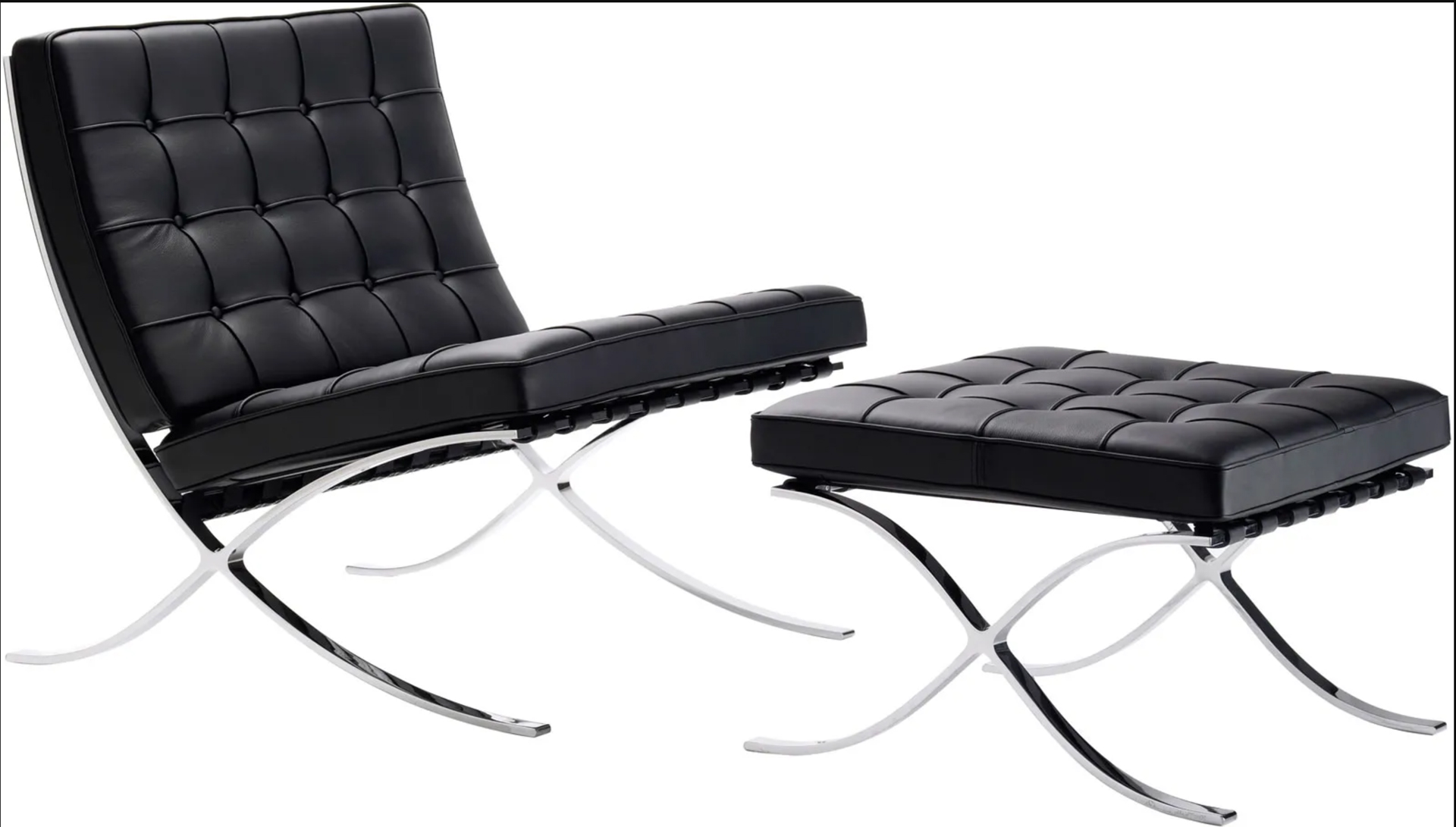
The Barcelona Chair, a masterpiece designed by architect Ludwig Mies van der Rohe, is a symbol of modern design and architectural innovation. Created in 1929 as part of the German Pavilion for the International Exposition in Barcelona, Spain, the chair is celebrated for its timeless elegance, craftsmanship, and revolutionary approach to form and function.
Mies van der Rohe’s design philosophy
Mies van der Rohe’s design philosophy for the Barcelona Chair was deeply rooted in the principles of the modernist movement. Influenced by the Bauhaus School, he aimed to create furniture that seamlessly blended aesthetics, comfort, and functionality. The chair’s inspiration can also be traced back to ancient Roman folding chairs, which Mies admired for their simplicity and efficiency.
Construction and Materials
One of the distinctive features of the Barcelona Chair is its minimalist and clean lines. Mies van der Rohe employed a meticulous construction process, using a combination of traditional craftsmanship and modern materials. The frame is made of chromed steel, welded, and polished to achieve a seamless appearance. The chair’s seat and backrest are made from individual leather square cushions, hand-stitched together with great precision. The choice of materials and craftsmanship not only enhances the chair’s visual appeal but also ensures durability and comfort.
Functionality and Comfort
Mies van der Rohe’s commitment to functionality is evident in the design of the Barcelona Chair. Its gently inclined seat and the strategic placement of cushions provide exceptional comfort without compromising on style. The chair’s low-slung profile and open design contribute to its versatility, making it suitable for various spaces, from living rooms to office lounges.
Recognition and Awards
The Barcelona Chair’s impact on modern design extends beyond its initial creation. Its success paved the way for Mies van der Rohe to continue exploring innovative furniture design, influencing subsequent generations of architects and designers. The chair has become synonymous with sophistication and refined taste, finding a place in upscale homes, offices, and cultural institutions worldwide.
The Barcelona Chair has received numerous accolades over the years, solidifying its status as a design classic. In 1977, it was awarded the “Design of the Century” award by Time magazine, further cementing its place as an iconic furniture design.
Cultural Significance
Beyond its functional and aesthetic qualities, the Barcelona Chair has become a cultural symbol associated with luxury and prestige. Its presence in films, television shows, and the offices of influential figures has contributed to its enduring popularity and cultural relevance.
Mies van der Rohe’s Background and Journey into Architecture & Furniture Design
Ludwig Mies van der Rohe, born on March 27, 1886, in Aachen, Germany, was a pioneering architect and designer who played a crucial role in the development of modernist architecture. His journey into architecture and later into furniture design was marked by a combination of education, mentorship, and evolving design philosophies.
Entry into Architecture:
1. Early Education:
Mies van der Rohe’s interest in architecture was sparked at a young age. After completing his formal education in Aachen, he worked briefly in his father’s stone-carving business. His early exposure to craftsmanship and materials would later influence his design ethos.
2. Apprenticeship with Bruno Paul:
In 1905, Mies moved to Berlin and began working for the architect and furniture designer Bruno Paul. This apprenticeship provided Mies with practical experience and allowed him to explore various design elements, laying the foundation for his future career.
3. Engagement with the Arts and Crafts Movement:
Mies became associated with the German Werkbund, an organization that aimed to integrate traditional crafts with modern industry. Through this involvement, he encountered the Arts and Crafts Movement’s ideas, which emphasized the importance of craftsmanship and the marriage of art with functional design.
4. Bauhaus School:
Mies van der Rohe’s most influential period came when he joined the Bauhaus School in 1930, initially as the director of the architecture department. The Bauhaus, a renowned school of design, played a pivotal role in shaping modernist principles. Mies’ time at the Bauhaus further refined his design philosophy, emphasizing functionality, simplicity, and the use of modern materials.
Transition to Furniture Design:
1. Introduction to Tubular Steel:
During the 1920s, Mies experimented with tubular steel as a material for furniture design. Inspired by the potential of this material, he created a series of tubular steel chairs that marked the beginning of his foray into furniture design.
2. Tugendhat and Barcelona Chairs:
Two of Mies van der Rohe’s most iconic furniture designs emerged during his later career. The Tugendhat Chair (1929), designed for the Tugendhat House in Czechoslovakia, and the Barcelona Chair (1929), created for the German Pavilion in Barcelona, showcase his mastery of materials, form, and proportion.
3. Collaboration with Lilly Reich:
Mies collaborated with the designer Lilly Reich on several furniture pieces. Their partnership was particularly significant in the development of iconic designs, including the Barcelona Chair and the Brno Chair, both of which continue to be celebrated examples of modernist furniture.
Ludwig Mies van der Rohe’s contributions to both architecture and furniture design have left an enduring legacy. His commitment to simplicity, functionality, and the innovative use of materials has influenced generations of architects and designers. The Barcelona Chair, in particular, remains an iconic piece of furniture that exemplifies Mies van der Rohe’s vision for modern design.
Art Nouveau was an international style of art, architecture, and applied art, especially the decorative arts, that flourished from about 1890 to 1910. The style is characterized by its use of flowing lines, organic forms, and asymmetry. Artists and designers sought to create a new style that was both beautiful and functional, and they often used natural forms as inspiration.
The Art Nouveau movement
It began in Belgium and France in the late 19th century, and it quickly spread to other parts of Europe and the United States. Some of the most famous Art Nouveau artists include Victor Horta, Hector Guimard, Alphonse Mucha, and Louis Comfort Tiffany.
Unfortunately, the movement was short-lived, but it had a lasting impact on the arts and design. The style’s use of flowing lines and organic forms can still be seen in many contemporary works of art and design.
Here are some of the key characteristics of Art Nouveau:
Flowing lines: Artists often used flowing lines to create a sense of movement and dynamism in their work. Natural forms, such as plants and flowers, often inspired these lines.
Asymmetry: Art Nouveau designs were often asymmetrical, which created a sense of movement and interest.
Nature: Nature was a major source of inspiration for Art Nouveau artists. They often used natural forms, such as plants and flowers, in their work.
Symbolism: Artists often used symbolism in their work. This symbolism often conveyed messages about beauty, nature, and the human spirit.
Art Nouveau was a diverse movement encompassing a wide range of artistic styles. However, all Art Nouveau works share some of the key characteristics listed above. If you see a work of art that features flowing lines, organic forms, asymmetry, and nature, then it is likely an example of Art Nouveau.
The Stickley style furniture is a type of furniture that is known for its sturdy construction, simple design, and high-quality materials. It is named after Gustav Stickley, an American furniture maker who popularized this style of furniture in the early 20th century. The Stickley style has become synonymous with the Arts and Crafts movement, which emphasized craftsmanship and simplicity in design. Stickley is considered one of the designers who make up the Craftsman Style of furniture design.
Gustav Stickley was an American furniture maker and designer who lived from 1858 to 1942. He was born in Osceola, Wisconsin, and began his career in the furniture industry at a young age, working as an apprentice in his uncle’s chair factory. After a few years of experience, Stickley and his brothers founded their own furniture company, called Stickley Brothers & Company, in 1883.
In 1898, Gustav Stickley established his furniture company, the Craftsman Workshops. The Craftsman Workshops produced furniture in the Arts and Crafts style, which emphasized traditional craftsmanship and simple, functional design. Stickley’s furniture was designed to be both beautiful and practical, and it quickly gained a reputation for its high quality and durability.
Stickley was also an influential writer and editor. He founded a magazine called The Craftsman in 1901, which was dedicated to promoting the Arts and Crafts movement and showcasing the work of American artisans. The magazine was hugely popular and helped popularize the Arts and Crafts furniture and design style.
Over the course of his career, Stickley’s furniture designs evolved, but they always remained true to his original vision of simple, functional design and traditional craftsmanship. Today, his furniture is highly sought after by collectors and aficionados of the Arts and Crafts style. Gustav Stickley’s legacy as a furniture maker and designer has had a lasting impact on American design and craftsmanship, and his work continues to be admired and celebrated today.
The Stickley style of furniture is characterized by several key features.
First and foremost, it is built to last. Stickley furniture is made from high-quality materials such as solid oak, cherry, and mahogany and is designed to withstand the wear and tear of everyday use. It is also known for its clean lines and simple, unadorned design. The furniture often features straight lines, flat panels, and exposed joinery, which give it a distinctive look and feel.
Another important aspect of Stickley Furniture is its attention to detail. Each piece is carefully crafted to ensure that every joint fits perfectly and that the furniture is both beautiful and functional. This attention to detail is evident in the furniture’s intricate joinery, which often includes mortise and tenon joints, dovetails, and finger joints.
Stickley furniture is also known for its unique finishes. The furniture is typically finished with a hand-rubbed stain or wax, which enhances the natural beauty of the wood and gives it a warm, inviting glow. The finish is often matte or satin, which gives the furniture a timeless, classic look that never goes out of style.
One of the reasons that Stickley furniture has remained so popular over the years is its versatility. While it was originally designed for use in Arts and Crafts homes, it can now be found in a wide range of settings, from traditional to modern. Stickley furniture is equally at home in a rustic cabin or a sleek urban loft, and its clean, simple lines make it a favorite of designers and homeowners alike.
In addition to its timeless design and exceptional craftsmanship, Stickley furniture is also known for its durability. It is built to last for generations, and many pieces of Stickley furniture are passed down from one generation to the next. This longevity is due in part to the use of high-quality materials and traditional joinery techniques, but it is also a testament to the care and attention that goes into each piece.
Stickley-style furniture is a timeless classic that has remained popular for over a century. Its simple, unadorned design, attention to detail, and exceptional craftsmanship make it a favorite of designers and homeowners alike. Whether you are looking for a traditional piece to add to your home’s decor or a modern piece that will stand the test of time, Stickley Furniture is a great choice. Its versatility, durability, and timeless design make it an investment you will enjoy for years.
The cost of making furniture can vary widely depending on several factors, including the type of furniture, materials used, craftsmanship, location, and scale of production. Here are some of the key factors that can influence the cost of making furniture:
Type of Furniture: The type of furniture you’re making will greatly impact the cost. For example, a simple side table will generally cost less to make than a complex dresser or rocking chair.
You will need less specialized tools to make a side table than you will need for making a rocking chair. You will also need fewer materials and skills to make a side table than a rocking chair.
Materials: The choice of materials significantly affects the cost. High-quality hardwoods, leather, and premium fabrics tend to be more expensive than synthetic materials or soft wood like pine.
Labor and Craftsmanship: If you are a one-man shop, learning how to do things will cost you time, and if you make a mistake, it will also cost you in materials. If you are hiring employees to help make furniture, a skilled craftsman will cost a premium.
Production Scale: The scale of production can affect costs. Mass-produced furniture might have lower costs per unit due to economies of scale, while small-scale or custom production might have higher costs.
Design and Complexity: Intricate designs and complex features can increase both material and labor costs.
Finishes and Detailing: Finishes such as stains, paints, varnishes, and special detailing can add to the cost.
Location: The cost of materials, labor, and overhead can vary depending on the region or country where the furniture is being produced.
Equipment and Tools: The cost of specialized tools and equipment required for manufacturing can impact overall costs.
Transportation and Shipping: If the furniture needs to be transported to a different location, transportation and shipping costs need to be considered.
Overhead and Business Costs: Costs associated with running a business, such as rent, utilities, insurance, and administrative expenses, will also contribute to the overall cost.
Quality and Brand: High-end brands often command higher prices due to their reputation for quality and craftsmanship.
It’s difficult to provide an exact cost without specific details about the type of furniture you’re referring to and the specific circumstances of its production. If you’re looking to make furniture, as a bespoke furniture maker, plan on growing your business over time. There is that joke: I can make it cheaper than the big box store right after I buy $100,000 worth of tools.
If you have decided it is too expensive to start your own furniture business, you can still have well-made custom furniture in your home. Contact a Profesional Furniture Maker to help you.
Art Nouveau-style furniture is a design movement that emerged in the late 19th century and was popular until the outbreak of World War I. The style was characterized by its organic shapes, curving lines, and floral motifs inspired by nature and the natural world.
The Art Nouveau movement challenged the ornate and decorative styles of the past, such as Rococo and Victorian. The movement celebrated the beauty of nature and the natural world and sought to bring this beauty into the home through furniture design. The result was furniture that was not only beautiful but also functional and comfortable.
One of its most noticeable features is the use of curving lines and organic shapes. This was a departure from earlier furniture styles’ such as the Arts and crafts with its straight lines and geometric shapes. The curves and twists of Art Nouveau furniture were often inspired by the shapes of plants and flowers, giving the furniture an almost sculptural quality.
Another key element of Art Nouveau furniture is the use of floral motifs. These were often incorporated into the design of the furniture through the use of inlays or carving. The floral motifs were often stylized and abstract, with an emphasis on the natural shapes and curves of the flowers.
The materials used in Art Nouveau furniture were also important. Wood was popular, especially in darker woods such as mahogany and walnut. Other materials, such as metal, glass, and ceramics, were also used, often as accent pieces. These materials were often embellished with intricate carvings or inlays to add to the overall decorative effect.
One of the most famous Art Nouveau furniture designers was Charles Rennie Mackintosh. Mackintosh was a Scottish designer who was known for his innovative furniture designs. His furniture was characterized by its clean lines, geometric shapes, and use of color and texture. Mackintosh’s designs were also influenced by Japanese art, which was becoming popular in Europe at the time.
Some of the most famous Art Nouveau furniture designers include Louis Comfort Tiffany, Victor Horta, and Hector Guimard. Tiffany was an American artist who is best known for his stained glass windows and lamps. Horta was a Belgian architect who is best known for his use of Art Nouveau in his buildings. Guimard was a French architect who is best known for his designs for the Paris Metro.
Art Nouveau furniture was not just a style, it was a way of life. The movement was about bringing art and beauty into everyday life, and furniture was an important part of this. Art Nouveau furniture was designed to be both functional and beautiful, and it remains popular today for its timeless beauty and innovative design.
How was Art Nouveau inspired by nature?
Art Nouveau was inspired by nature in many ways. Artists and designers of the movement were drawn to the beauty and organic forms of plants and flowers, and they often used these forms as inspiration for their work.
One of the most obvious ways in which Art Nouveau was inspired by nature is in its use of flowing lines. The curves of plants and flowers often inspired these lines, and they created a sense of movement and dynamism in Art Nouveau designs.
Another way in which Art Nouveau was inspired by nature is in its use of organic forms. These forms were often used to create a sense of unity and harmony between the different elements of a design. For example, the curves of a chair’s back might be echoed in the design of its seat, or the shape of a vase might be echoed in its base design.
Art Nouveau was inspired by nature in its use of color. Artists and designers of the movement often used bright, vibrant colors to create a sense of energy and excitement in their work. The colors of plants and flowers often inspired these colors, and they helped create a sense of harmony between the different design elements.
Here are some of the reasons why Art Nouveau artists and designers used flowing lines:
To create a sense of movement and dynamism. Flowing lines are often associated with movement and energy, which is why Art Nouveau artists and designers used them to create a sense of dynamism in their work.
To create a sense of unity and harmony. Flowing lines can help to create a sense of unity and harmony between the different elements of a design. For example, the curves of a chair’s back might be echoed in the design of its seat, or the shape of a vase might be echoed in the design of its base.
To evoke a sense of nature. Flowing lines are often found in nature, so Art Nouveau artists and designers used them to evoke a sense of nature in their work.
The flowing lines of Art Nouveau are a major part of what makes the style so unique and distinctive. They help to create a sense of movement, dynamism, and unity in Art Nouveau designs.
Japanese art refers to the various forms of visual and aesthetic expressions that have been created in Japan throughout its long and rich history. Japanese art encompasses a wide range of mediums and styles, often influenced by cultural, religious, and historical factors. Here are some key aspects and periods of Japanese art:
Traditional Japanese Art:
Ukiyo-e: A popular woodblock printing style that emerged during the Edo period (17th to 19th century). Ukiyo-e prints often depicted landscapes, kabuki actors, beautiful women, and scenes from daily life.
Sumi-e: Also known as Japanese ink painting, this minimalist style uses black ink and brushstrokes to create expressive and often monochromatic works.
Kintsugi: The art of repairing broken pottery with lacquer mixed with powdered gold, silver, or platinum, resulting in beautiful, visible repairs.
Ikebana: The Japanese art of flower arrangement that emphasizes balance, harmony, and simplicity.
Tea Ceremony: Known as “chanoyu” or “sado,” this ritualistic practice involves the preparation and presentation of matcha tea in a serene and aesthetically pleasing manner.
Historical Periods:
Heian Period (794–1185): Characterized by classical Japanese aesthetics, literature, and art, including the creation of illuminated manuscripts and courtly paintings.
Kamakura and Muromachi Periods (1185–1573): Saw the rise of Zen Buddhism and the development of monochrome ink painting, Zen gardens, and samurai culture.
Edo Period (1603–1868): Marked the flourishing of ukiyo-e prints, as well as the emergence of kabuki and bunraku theater, and the revival of traditional painting styles.
Meiji Period (1868–1912): Witnessed modernization and Western influence, leading to changes in art styles and techniques.
Contemporary Japanese Art:
Contemporary Japanese art reflects both traditional influences and modern innovations, often experimenting with new materials, technologies, and concepts.
Artists like Yayoi Kusama, Takashi Murakami, and Yoshitomo Nara have gained international recognition for their unique and innovative contributions to contemporary art.
Japanese art is characterized by its attention to detail, connection to nature, emphasis on harmony and balance, and an aesthetic philosophy that often values imperfection and transience. It has left a lasting impact on the global art world and continues to evolve with the changing cultural landscape.
I hope you enjoyed this article; Japanese art has been a huge influence on my Japanese furniture designs.
Mid-century modern furniture refers to a furniture style popularized during the mid-20th century, particularly between the 1940s and 1960s. This style is characterized by a focus on simplicity, functionality, and angular shapes, with an emphasis on the use of natural materials such as wood, leather, and metal.
This furniture style is known for its clean lines and geometric shapes, which often feature simple, understated designs. Some of the most iconic mid-century modern furniture pieces include the Eames Lounge Chair, the Saarinen Tulip Table, and the Noguchi Coffee Table.
It continues to be popular today, both as a vintage collectible and as a source of inspiration for contemporary designers. The style’s emphasis on simplicity, functionality, and timeless design has made it a classic that remains relevant and appealing to many people.
The style has become increasingly popular in recent years. The designers of this era believed that good design should be accessible to everyone as well as beautiful and functional.
It was heavily influenced by the Bauhaus movement, which emphasized the use of modern materials such as steel, glass, and concrete. These materials accentuated the use of wood, which was often used for its warmth and organic feel.
If you are interested in incorporating mid-century modern furniture into your home, there are many ways to do so. Look for vintage pieces at flea markets or antique stores, or invest in high-quality reproductions from reputable furniture makers. Don’t be afraid to mix and match styles and eras; mid-century modern pieces can add a unique and timeless touch to any room. Mid-century modern furniture is a classic style that has stood the test of time.
If you are into this furniture style, be sure to contact a Mid-century furniture designer to have a custom piece designed and built for your home.
“Custom” and “bespoke” are both terms often used to describe furniture that is made to order according to a customer’s specifications, but there can be subtle differences in their meanings depending on the context and the industry. Custom Furniture is more about adapting an existing design, while Bespoke Furniture goes above and beyond to personalize your furniture needs.
Custom Furniture:Custom furniture generally refers to pieces that are made to specific dimensions, designs, and styles based on a customer’s preferences. This can involve selecting or modifying existing designs to fit the customer’s requirements. In the context of custom furniture, there might be a range of options to choose from, and customers can personalize their choices within those options. It’s a more flexible and adaptable approach to manufacturing furniture according to individual preferences.
Bespoke Furniture: The term “bespoke” originates in British tailoring and is often used to describe entirely tailored and created from scratch based on the customer’s unique requirements. Bespoke furniture takes personalization to a higher level, often involving a deep collaboration between the customer and the artisan or craftsman. With bespoke furniture, the customer has a higher level of control over every aspect of the design, materials, and features. This highly individualized approach can result in unique pieces that perfectly match the customer’s vision.
In summary, the main difference lies in the level of personalization and control over the design and manufacturing process: Custom Furniture is more about adapting existing designs or options to suit the customer’s needs, often offering a degree of personalization within a set of predefined choices. Bespoke Furniture takes personalization to an extreme, involving the creation of entirely unique and individual pieces from scratch, where the customer’s preferences drive every aspect of the design and production.
Custom furniture can be more expensive than mass-produced or ready-made furniture, but the cost difference can vary depending on several factors. Most Custom Furniture has been well thought out and designed by a craftsman who takes great pride in his work. It takes time and skill to create something unique. The materials used to create custom-made furniture are often of higher quality and, thus, more expensive. Here are some additional reasons why custom furniture might be more expensive:
Labor and Expertise: Custom furniture often requires skilled artisans or craftsmen who work on designing, creating, and finishing the piece according to the client’s specifications. Their expertise and time contribute to the higher cost.
Design and Complexity: Unique designs and intricate details in custom furniture can demand more time and effort to create, increasing the overall cost compared to standardized designs.
Size and Scale: Custom furniture might be made to fit specific spaces, which can lead to higher costs due to the need for precise measurements and adjustments.
Customization: The ability to customize aspects like size, shape, color, and finishes in custom furniture can lead to additional costs, as these options require extra effort and resources.
Limited Production: Custom furniture is typically produced in smaller quantities, resulting in higher production costs than mass-produced items that benefit from economies of scale.
Quality and Durability: Custom furniture is often associated with higher quality and longer lifespan due to the use of better materials and craftsmanship. This can justify a higher price tag.
It’s important to note that while custom furniture can be more expensive, it offers the advantage of owning a unique, personalized piece that meets your exact specifications and design preferences. The decision to invest in custom furniture depends on your budget, the value you place on customization and uniqueness, and your overall design goals.
One last tip on how to help make custom furniture is to work with a local furniture maker, this will save you some money on shipping. I am a furniture maker in Denver, Colorado.
Dieter Rams’ Ten Principles of Design stand as a testament to his influential legacy in the field of industrial design. As the chief designer for Braun and a key figure at the renowned German design firm, Vitsœ, Rams’ principles have left an indelible mark on the way we perceive and approach design. Rooted in simplicity, functionality, and sustainability, these principles have transcended time and continue to shape the ethos of modern design, inspiring generations of designers to create products that seamlessly blend aesthetic elegance with practical utility. From the reduction of excess to championing innovative and honest materials, Rams’ principles provide a comprehensive framework that underscores the profound impact of thoughtful design on both form and function.
The principle of “Good design makes a product useful” goes beyond mere aesthetics, delving into a product’s core functionality and purpose. It encapsulates the idea that design should enhance the usability and functionality of a product, creating a seamless and efficient user experience.
The principle that Good Design is Aesthetic highlights Rams’ commitment to creating visually pleasing products and delves into the nuanced subjectivity of aesthetics.
The principle of Good design makes a product understandable, encapsulates the essence of design’s role in enhancing the user experience, and creates products that seamlessly integrate into our lives.
The principle of “good design is unobtrusive” offers profound insights into how the interplay between form and function can be orchestrated to create visually captivating and highly functional designs.
The principle of honesty emphasizes that a design should never deceive or manipulate users. Instead, it should remain true to its purpose, functionality, and aesthetics.
“Good Design is Long Lasting” resonates deeply with bespoke furniture makers. In this world of craftsmanship, a profound commitment exists to create pieces that stand the test of time.
The principle of “Good Design is Thorough Down to the Last Detail” underscores the importance of meticulous planning, careful consideration, and a focus on perfection within the realm of design.
Dieter Rams’ Principle that “Good Design is Environmentally Friendly” has become an important aspect in a world that is becoming increasingly conscious of its ecological footprint.
Less, but better – because it concentrates on the essential aspects, and products are not burdened with non-essentials.
Dieter Rams’ Principles of Good Design have a remarkable simplicity and comprehensibility quality, making them accessible to designers and enthusiasts across various disciplines. However, their strength lies in their inherent breadth, which allows them to transcend rigid definitions and adapt to diverse design contexts. While each principle, from “Good Design is Innovative” to “Good Design is Long-lasting,” provides a clear direction, they do not prescribe specific solutions, granting designers the flexibility to apply them in ways that suit their unique projects. This balance between simplicity and flexibility underscores Rams’ genius, as his principles offer a guiding compass rather than a rigid map, encouraging creativity and innovation while adhering to the core values of functional and aesthetic excellence.
In the world of design, honesty is not just about being transparent in communication or adhering to ethical practices; it’s about the essence of the design itself. Dieter Rams highlighted this concept in his principle of design: “Good Design is Honest.” This principle is a reminder that design should reflect truthfulness, authenticity, and integrity, creating products that resonate with users on a deeper level.
The Essence of Honesty in Design
Rams’ principle of honesty emphasizes that a design should never deceive or manipulate users. Instead, it should remain true to its purpose, functionality, and aesthetics.
When applied to products, this principle urges designers to avoid exaggeration or overstatement. A product’s features and capabilities should be presented accurately, without embellishment or false promises. This approach fosters trust between the consumer and the product and contributes to the product’s longevity and value. Honest design establishes a strong foundation for lasting relationships between users and the objects they interact with daily.
The Art of Subtle Manipulation
While Rams’ principle of honesty is noble, the reality of design often involves subtler nuances. Critics argue that designers strategically employ certain techniques to divert attention from flaws and emphasize visually appealing elements. For instance, designers might use captivating visuals, colors, and typography to distract users from minor defects or shortcomings.
In the realm of digital design, such as website layouts or app interfaces, designers have been known to strategically place visually attractive elements to influence user behavior. This might involve designing a button or link in a prominent location, guiding users to specific actions that align with the designer’s goals. This manipulation of visual hierarchy, while not necessarily deceptive, can lead users toward decisions they might not have taken otherwise.
Finding a balance between these opposing forces is where the art of design truly shines. Designers can uphold honesty while utilizing their craft to guide user attention in a positive direction. Instead of relying solely on manipulation, they can focus on emphasizing genuine strengths and benefits, showcasing the product’s value without resorting to deceptive tactics.
Truth in Materials: Authenticity in Design
A significant extension of Dietrich Rams’ principle of honesty in design is the concept of “truth in materials.” This principle underscores the importance of using materials in their natural state and allowing their inherent characteristics to shine through. Designers are encouraged to embrace the unique qualities of each material rather than attempting to mimic another.
When designers artificially manipulate materials to imitate something they are not, they risk deceiving users and eroding trust. Users expect a product’s visual and tactile experiences to be genuine, and altering materials to create a false impression goes against the principle of honesty. However, this might not always be an unethical decision. If a client does not have the budget for a more expensive wood such as walnut, the designer may make a decision to stain a cheaper wood to resemble walnut. This practice may diminish the authenticity of the design since the piece is no longer made of genuine walnut wood. However, staining cheaper wood may bring the cost of building the furniture into the customer’s budget. Now we are splitting hairs, the client approved of the decision and knows it’s not real walnut, but the casual observer may be fooled into thinking something is what it is not. The line of ethics is drawn in a different spot in the sand for each person and each situation. The world is not as simple as we often try to make it.
When Design Becomes Art
Designers can explore ways to enhance the aesthetics of a material without distorting its essence. This might involve selecting materials that naturally align with the desired outcome and celebrating their inherent properties through thoughtful design and craftsmanship. By respecting and honoring the authenticity of materials, designers stay true to their ethical responsibility and contribute to creating products that are more meaningful, enduring, and respectful of the user’s experience. However, Manipulating these materials can also yield thought-provoking products that fall in line with client expectations.
Dietrich Rams’ principle that “Good Design is Honest” reminds designers of ethical responsibilities. Honesty in design fosters trust and contributes to products’ overall sustainability and impact. While counterpoints suggest that some level of subtle manipulation might be present in a design, the heart of the matter lies in the intention behind the design choices. Are you making design choices for good or evil? Where is your line in the sand?
 Login
Login